
Hand-Carved Wooden Bird — the maker's story
"They all come from one tree. And I'm nearly at the end of it."
Why Wilf Howlett (73), a Norfolk Broads woodcarver, is letting the last of his hand-carved birds go.
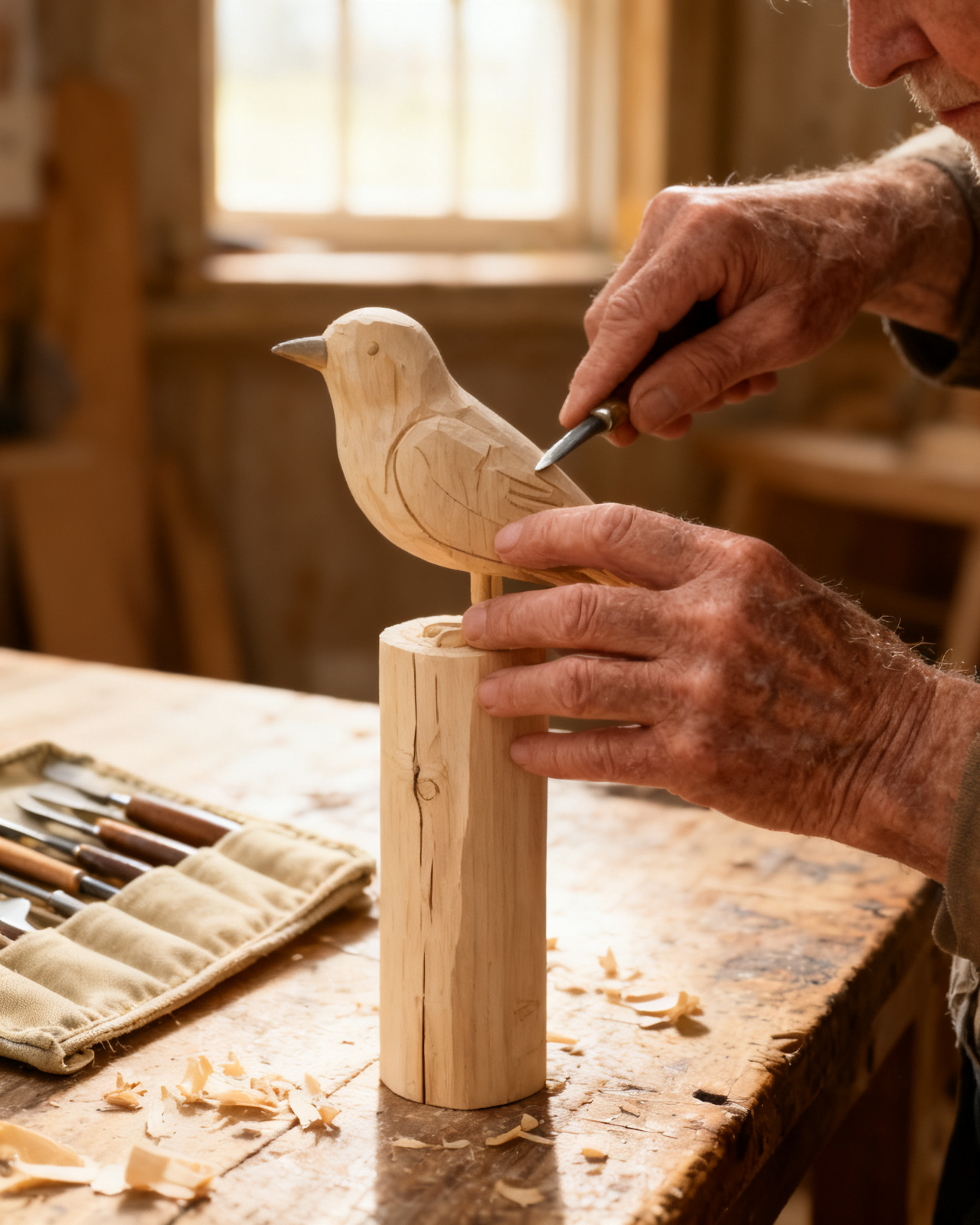
Wilf Howlett (73) at his bench on the edge of the Norfolk Broads — shaping the last birds from a lime that came down in the Great Storm of 1987.
Hickling, Norfolk. A still morning in June, mist coming off the reed beds. The carving shed sits at the bottom of the garden, where the land gives way to water — a low brick-and-board building that smells of cut wood, linseed oil and forty years of pipe smoke. On the bench there are gouges laid out in a worn canvas roll, a jam jar of brushes, a tin of milk paint gone tacky at the rim, and a curl of pale shavings building up around a half-finished bird no bigger than a real one. On the high shelf, watching over it all, sits a row of old wildfowling decoys — mallard, teal, a pintail — blackened with age. His father's. His grandfather's before that.
Wilf Howlett turns the little bird in his hands the way he has every morning for the better part of fifty years. He sets it down, picks up a knife, takes a sliver of wood from under the wing. Then he stops.
"This is the last of it," he says. Not sad, exactly. Just plain. "Not the carving — I'll carve till they put me down. The wood. There's only so much of it left, and there'll be no more after."
He nods at a stack of timber in the corner, pale and close-grained, each billet numbered in pencil. "That's all lime. Came off one tree."
One tree, and the storm that brought it down
In October 1987, the great storm that tore across the south and east of England took down some fifteen million trees in a single night. One of them was a vast old lime that had stood in the grounds of a hall not three miles from Wilf's shed. "Two hundred years old if it was a day. They were going to burn it."
He didn't let them. He begged the trunk off the estate, hauled it home in sections behind a borrowed tractor, and stacked it to season.
Lime — limewood, the carver's wood since Grinling Gibbons carved his garlands for St Paul's — does not dry quickly. "A rule of thumb," Wilf says. "An inch a year. A trunk that size, you're waiting the best part of your life." He has been carving birds from that one tree, billet by billet, for thirty-eight years. And now the pile in the corner is nearly gone.
A way of working that is quietly vanishing
What's disappearing isn't just one man's timber. It's the whole way of working.
Heritage Crafts — the body that keeps Britain's official Red List of Endangered Crafts — now lists dozens of traditional skills as "endangered" or "critically endangered," with too few working makers left to pass them on. Hand-carving of the kind Wilf does — a single block, a knife, a gouge, an eye trained over decades — is exactly the sort of slow craft the list was made to mourn.
"There used to be a carver in every market town," he says. "Decoy men all down this coast. Now? I don't know of another doing it by hand within fifty miles of here." He shrugs. "Folk still buy 'carved' wooden birds. Shops are full of them. But most of them have never met a chisel."
What most people don't realise about a "carved" wooden bird
And here is the thing most people don't realise.
Almost every "hand-carved wooden bird" you can buy today was never carved at all. "They're cast," Wilf says. "Resin, poured into a mould, painted by a machine that sprays a thousand an hour. Or they're routed — a computer drives a cutter through cheap pine, same shape every time, down to the last feather." He picks one of his own birds up off the sill. "Looks the same in a photograph. It's the opposite of this."
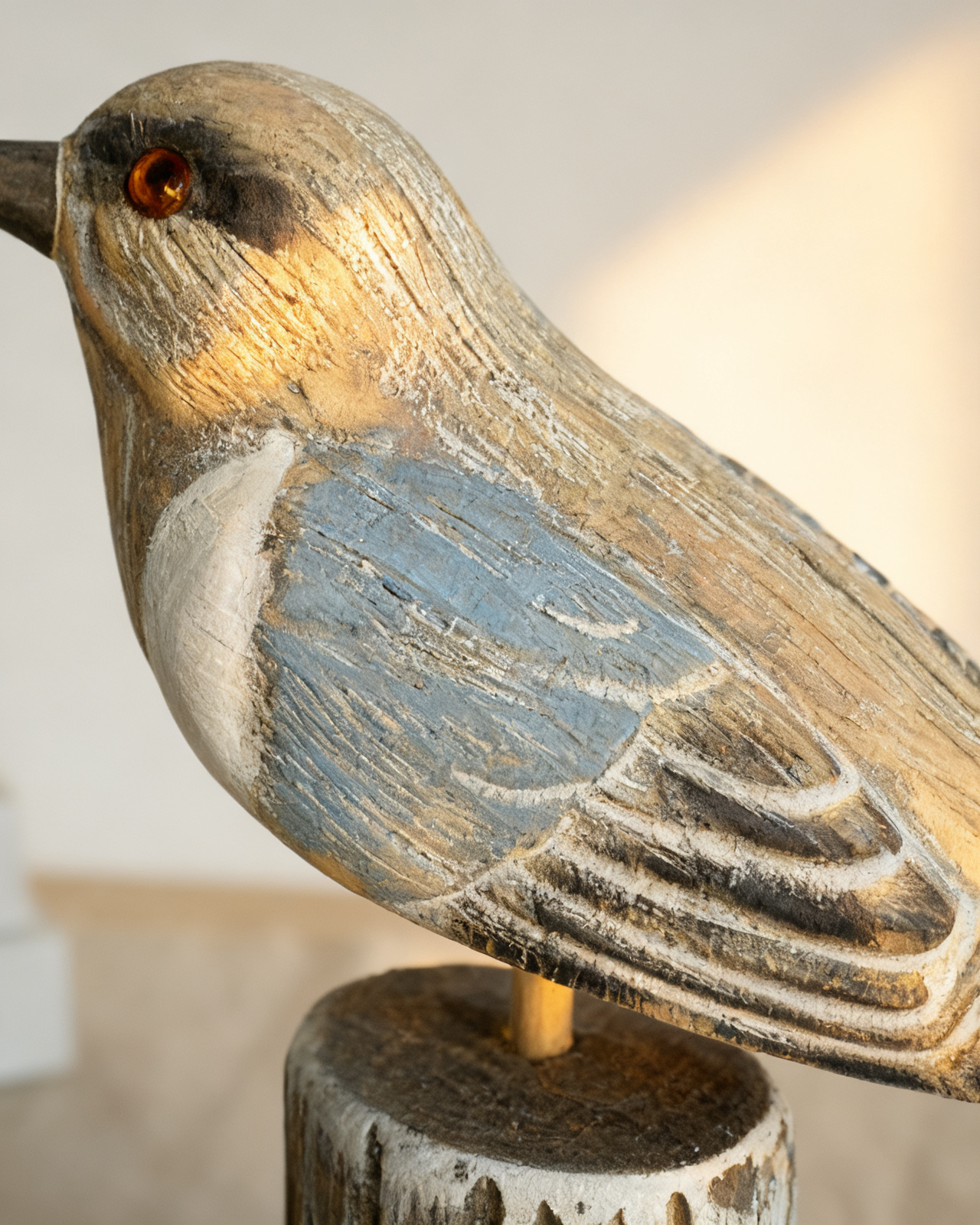
Run your thumb up the back: the little flats and ridges are where the gouge went. That texture is the proof no machine ever touched it.
You can tell the moment you hold one, he says. A cast bird has no grain — because resin has no grain. A routed bird has no tool marks — because no tool with a hand behind it ever touched it. "Run your thumb up the back of mine. You'll feel where the gouge went — little flats, little ridges. That's not a flaw. That's the carving. That's me."
There's a reason it has to be lime, too. "Most woods fight you. The grain runs one way, you carve against it, and it tears. Lime has hardly any grain to speak of — you can cut it in any direction, clean, like cheese off a wire. It's the only wood fine enough to take a bird's face." Pine splits. Oak is too coarse for the eye. "Lime, properly seasoned, holds the detail. But you cannot hurry the seasoning. That's the whole trouble. That's why there'll be no more after this tree."
How it started — on a kitchen windowsill
Wilf didn't set out to make songbirds. He grew up carving working decoys — the heavy, hollow ducks his father floated out on the Broads before dawn to draw the wildfowl in. "That was a trade then. You carved to eat." When the wildfowling faded, the decoys stopped paying. But people had started noticing the little garden birds he carved for himself, on Sunday afternoons, out of the offcuts.
"My wife put one on the kitchen windowsill — a robin. The woman from the post office saw it and wanted one. Then her sister. Then it was the church fete." He smiles for the first time. "I never advertised a day in my life. They just went."
What sets Wilf's carved birds apart
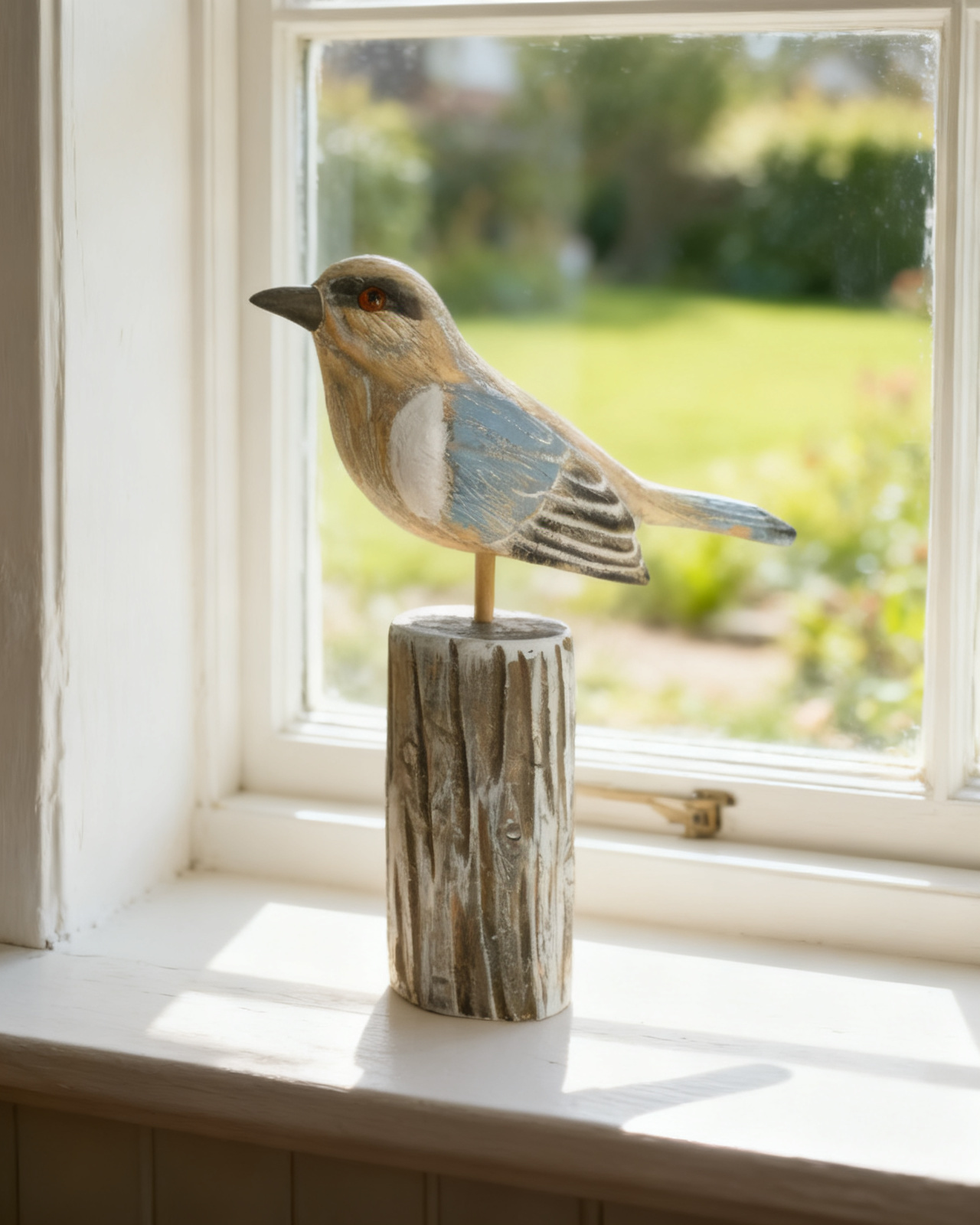
The finished bird on its turned lime post — blue-grey wing, cream breast, the dark eye-mask of a real garden bird and a single bead of amber for the eye.
Each bird begins as a single block of that seasoned lime — never glued, never joined. "It's one piece of wood. The whole bird and the tail, all of it, from one billet. That way the grain runs through it the way it ran through the tree." He carves it down with gouge and knife — no machine, no router — until it feels right in the hand. It takes the better part of a day. Then it is mounted on a turned post of the same lime and painted, by hand, in soft milk paint and limewash, then gently distressed — the old wildfowl-decoy finish, made to look as though it has already lived a quiet life on a windowsill.
- Carved from a single block of seasoned English lime — never cast, never routed, never glued. The grain runs through the whole bird, so each one is solid, warm, and built to be handed down.
- Hand-cut with gouge and knife — you can feel the tool marks up the back and under the wing. That texture is the proof no machine ever touched it.
- One of one, every time — a knife in a hand cannot repeat itself. The tilt of the head, the set of the tail, the wear in the paint — yours exists nowhere else.
- Finished in milk paint and limewash — the traditional decoy finish, dry-brushed and softly distressed so it looks as though it has always sat in the light.
- Mounted ready to perch — on its own turned lime post. No feeding, no watering, no winter shelter.
- From one fallen tree — every bird in this final run is carved from the same 1987-storm lime. When the last billet is gone, these birds are finished for good.
What people say about Wilf's birds
"It sits on my kitchen sill and I find myself touching it every time the kettle's on. You can feel the little ridges where it's been carved — it's warm, not cold like the resin ones. A real thing in a house full of plastic."
"Bought the little blue one for my husband when he retired — he'd kept budgies all his life. He turned it over, saw the grain run right through it, and went quiet. He doesn't go quiet. Worth every penny."
"I'll be honest, I half expected a tourist-shop ornament. It is not. It's properly carved, the paint is soft and lovely, and no two on Wilf's table were alike. Knowing it came out of one old tree makes it feel like something you keep."
The kind of gift someone keeps
What makes one of Wilf's birds such a gift isn't only the carving. It is the wood it came from, and the hands that shaped it.
"When you give someone one of these," he says, "you're not giving them an ornament off a shelf. You're giving them a piece of a tree that stood for two hundred years and came down in a storm — that a man sat and carved by hand at the edge of the water. There'll never be another off the same wood. The people who get one, they tend to understand that."
Secure one of the last birds
Reserve one of the final hand-carved birds from Wilf's bench — from the last of the storm-lime — before the wood runs out and they become part of history.
Check availability →Wilf Howlett's bird is not just a decorative object. It is a living piece of craft — carved by hand from a single block of two-hundred-year-old English lime, by a man with a lifetime at the bench, from the last of a tree that fell in the great storm of 1987.
Thank you, Wilf. For a lifetime of birds out of one good tree. 🕊️✨
DISCLAIMER: The owner has a financial connection to the products and services promoted on this website. The product/service may be offered by a company outside your local jurisdiction. Return costs are the customer's responsibility and additional charges, such as customs duties or taxes, may apply.
⚠ ADVERTISING | PAID ADVERTISEMENT — This article is a paid advertisement and not independent editorial reporting.
Representation notice
The story told in this article is a fictional advertising presentation. The person "Wilfred 'Wilf' Howlett", his workshop, family, quotations and biographical details are invented and used solely for creative product presentation. They do not describe real people or real events. Images are illustrative.
Customer review notice
The customer opinions shown are example representations and describe possible experiences with the product. Individual experiences can vary. Names have been changed for privacy.
Product notice
The promoted product is a decorative hand-carved wooden bird ornament. Statements about "hand craft" refer to craft elements in production and finishing; materials are natural wood and finishes may vary in grain, colour and markings. The product has no medical or therapeutic effect.
Financial connection
The operator of this website has a financial connection to the advertised products and may receive commission for sales made through links on this page.
Seller: Ecomcloud Trading LLP, 32 Kinburn Street, London, SE16 6DE, United Kingdom · Reg. OC83840 · info@latestfinds.co.uk · © 2026 latestfinds.