
Hand-Carved Wooden Bird — the maker's story
"The wood I gave my life to is the thing that's killing me. I'm carving anyway, until I can't breathe to."
Why Maurice Quill (79), a woodcarver in Wensleydale, is letting the last of his hand-carved birds go.
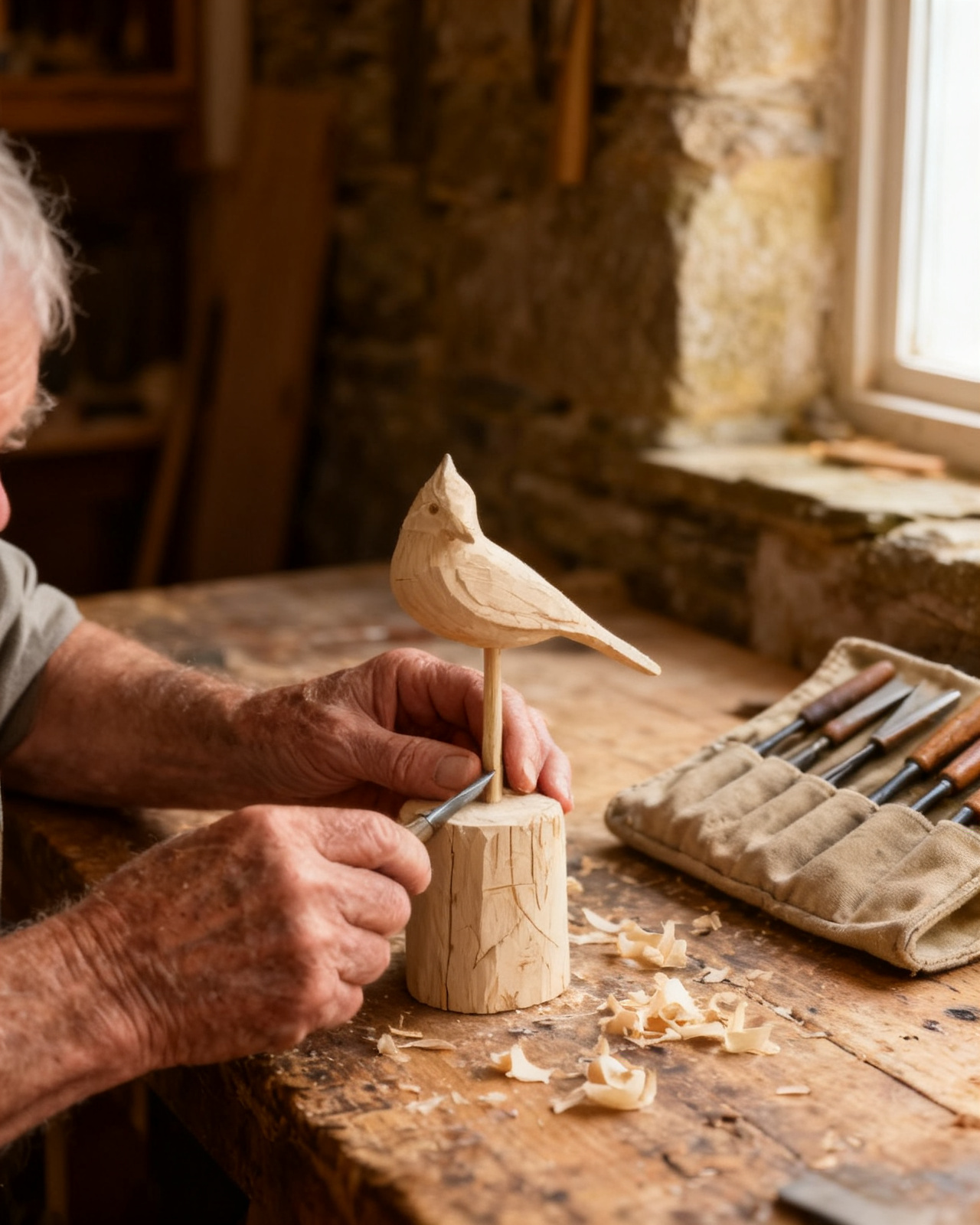
Maurice Quill (79) in his workshop above the dale at Wensleydale, the Yorkshire Dales. After more than fifty-five years at the bench, he is finishing the last birds his lungs will let him make.
Wensleydale, the Yorkshire Dales. A still, cold morning in June, mist still sitting low in the bottom of the dale. Maurice's workshop is a stone shed across the yard from the house, one window facing the fell. It smells of cut lime, linseed oil and old sawdust. On the bench there is a canvas roll of gouges worn thin with sharpening, a strop gone black with use, a tin of wax with the lid off, and a half-carved bird no bigger than the real thing — pale, bare, waiting. Along the sill, a row of finished birds, warm brown in the wood, each with a small crest, every one of them turned to the light.
In the corner, quiet as the rest of it, stands a green cylinder on a little trolley, a clear line running from it to the soft tubing across his face. Maurice picks up the half-finished bird the way he has every morning for fifty-five years. He turns it once in the light, sets the gouge to the breast, and takes a cut. Then another. By the fourth his shoulders have begun to lift with the effort of breathing, and he stops, one hand flat on the bench, and waits for the air to come back.
"Ten minutes," he says, when he can. Not bitter. Just plain. "I get about ten minutes at the bench now, then it finishes me and I have to sit." He looks at the curl of pale shaving on the wood. "Fifty-five years that smell has been the best part of my day. Turns out it's been the worst part too. I just didn't know it."
But this batch is different. It is the last.
A craft, and a carver, both running out of breath
Maurice is not alone, in two ways.
Heritage Crafts — the charity that keeps Britain's official Red List of Endangered Crafts — now lists dozens of traditional skills as "endangered" or "critically endangered", with too few working makers left to pass them on. Hand-carving of the kind Maurice does — a single block, a knife, a gouge, a lifetime in the hands — is exactly the slow craft the list was made to mourn.
And pulmonary fibrosis, the condition scarring his lungs, is far more common than most people think. According to the British Lung Foundation it affects tens of thousands of people in the United Kingdom, many of them older men who spent their working lives around fine dust, and for the commonest form there is no cure — the scarring only goes one way. For most people the cause is never found. For Maurice it is no mystery at all.
"They asked me what I'd breathed in over the years," he says. "I told them. Wood. Fifty-five years of wood." He taps the line at his cheek. "Lime's a soft wood — carves like a dream, but it powders. Fine as flour. You don't see it going in. You only find out forty years later, when you can't get up the yard without stopping."
"I've tried everything to keep going"
He has, too.
A mask that fogged his glasses and steamed up so he couldn't see the cut. A dust extractor that roared so loud his wife thought the tractor had started in the shed. A stool by the bench so he could work sitting down, and a rule — ten minutes, then rest, then ten more. "It's a daft way to carve a bird," he says. "Stop-start, stop-start. A bird wants doing in one long go, while your hand's warm and your eye's in. Now I do it in pieces, over days, between sitting down."
So he has carved on, slowly, in instalments. The skill is all still there — fifty-five years of it, in the hands. It is only the breath that has gone. "The doctor told me to put the gouges down," he says. "Kind man. But you don't spend a life learning a thing and then sit and watch the telly while you've still got hands. I'll carve while I can carve. When I can't, I'll stop. Not before."
What most people don't realise about a "hand-carved" wooden bird
And here is the thing most people never think about.
Almost every "hand-carved wooden bird" you can buy today was never carved at all. "They're cast," Maurice says. "Resin, poured into a rubber mould, sprayed in a clean room by a machine that does a thousand a day — and not a speck of dust the whole time. Or they're routed — a computer drives a cutter through cheap timber, same bird every time, down to the last feather." He picks one of his own off the sill. "Looks the same in a photograph. It is the opposite of this."
You can tell the moment you hold one, he says. A cast bird has no grain, because resin has no grain. A routed bird has no tool marks, because no tool with a hand behind it ever touched it. "Run your thumb up the back of mine. You'll feel little flats, little ridges, where the gouge went. That's not a flaw. That's the carving. That's me."
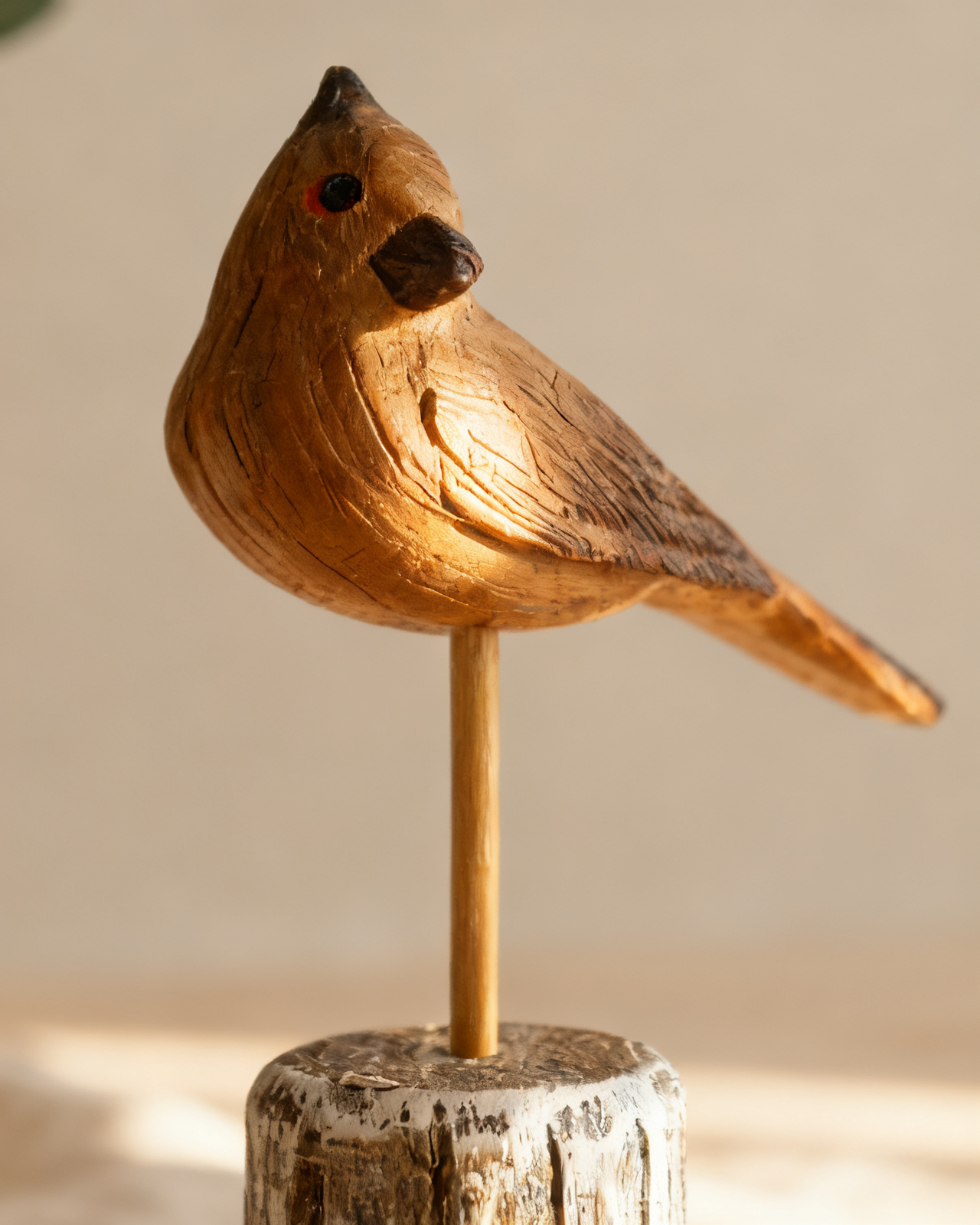
Run your thumb up the back: the little flats and ridges are where the gouge went. Left bare in the natural wood — the grain, and every cut, on full show.
Then he says the thing that stops you.
"And here's the bit nobody thinks about. The very thing that proves mine was truly carved — the dust — is the thing that's done for my lungs. A resin bird is made in a clean room because there's nothing to cut, nothing to make dust. Mine made dust with every single stroke for fifty-five years. The grain you can see, the tool marks you can feel — that's the same dust, breathed in, one cut at a time." He turns the little bird over. "You can't carve real wood without making it. And you can't breathe it for fifty years and not pay. The proof it's real and the thing that's killing me are the one and the same. Funny old thing."
How it started — a joiner who carved in the quiet months
Maurice did not set out to make songbirds.
He was a joiner and a wheelwright by trade — doors and gates and farm carts, the slow timber work of the dale. In the quiet months, when the farm work thinned and the orders dried up, he carved — little birds off the fell, from offcuts of lime too small for anything else — and took them down to the Dales markets on a Saturday. "A few bob each. Pocket money, really." For years it was only a sideline; the wheels and the gates paid the bills. When the trade for cartwrights finally died out, the birds became the work.
"I never advertised a day in my life. One went on a stall at Hawes market, and a woman wanted it, then her sister, then it was Christmas orders." For thirty years it was just Maurice at the bench, and the birds going out across the Dales, then far past them, one at a time.
What sets Maurice's birds apart
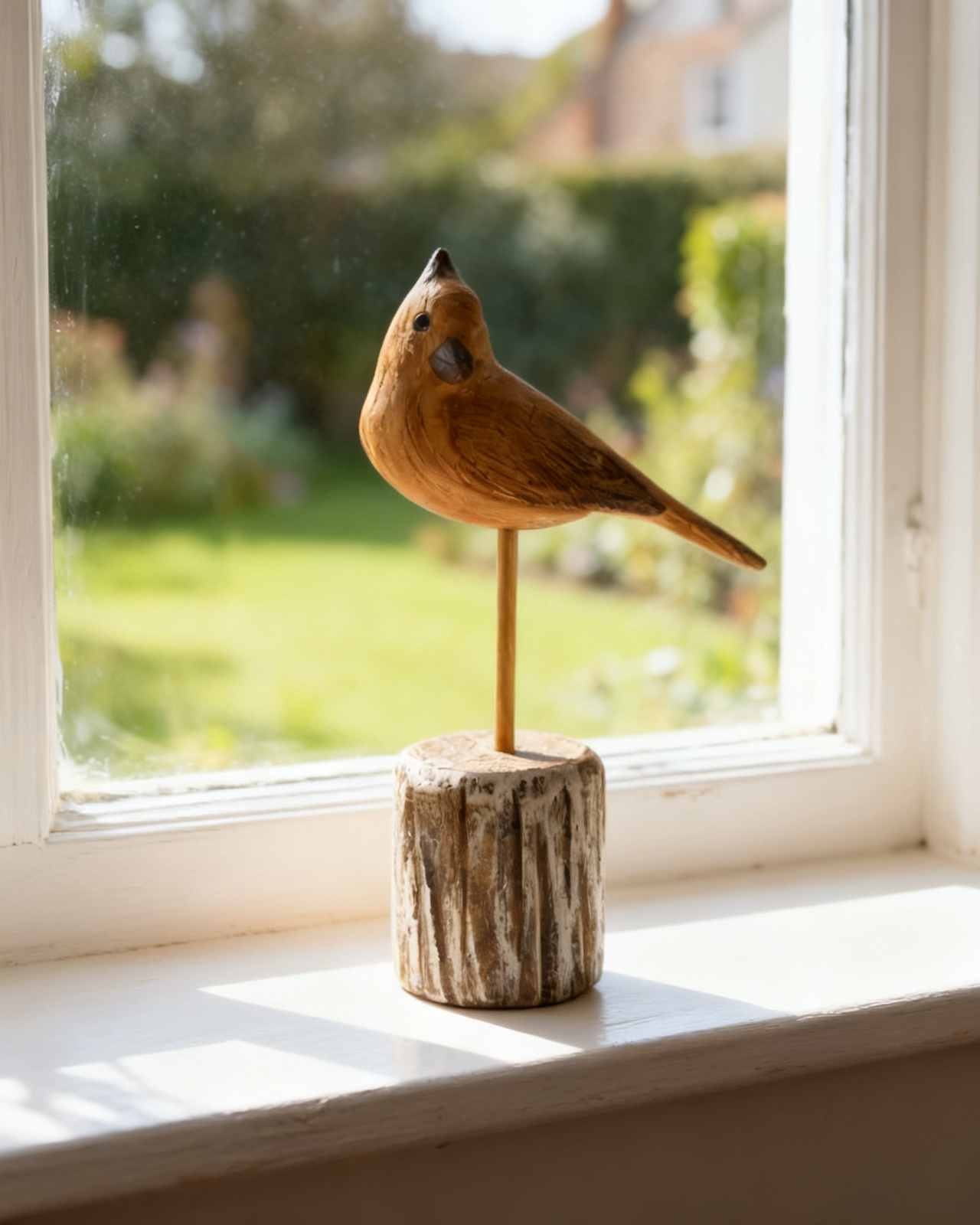
Each bird begins as a single block of seasoned lime — and is left bare, so you can see and feel every cut.
Each bird begins as a single block of seasoned lime — never glued, never joined. It is cut down with gouge and knife until the breast, the small crest and the long tail feel right in the hand; then mounted on a turned post, distressed and waxed, and left bare — the natural warm-brown of the wood, so the grain shows through and every gouge stays on view. No paint to hide behind. Just the wood, and the work.
- Carved from a single block of seasoned lime — never cast in resin, never routed by machine, never glued. The grain runs through the whole bird the way it ran through the tree.
- Left in bare, natural wood — no paint, nowhere to hide. The warm brown of the lime and every tool mark stay on show. What you see is exactly what the gouge did.
- Hand-cut with gouge and knife — you can feel the little flats and ridges up the back and under the wing. That texture is the proof no machine touched it — and the dust that proof is made of is the thing that scarred Maurice's lungs.
- One of one, every time — a knife in a hand cannot repeat itself. The tilt of the head, the set of the small crest, the run of the grain: yours exists nowhere else.
- Mounted on a distressed turned post — softly aged so it looks as though it has always sat in the light; at home on a windowsill, a shelf or a mantel.
- No upkeep at all — no feeding, no watering, no winter shelter. A wipe of the dust now and then is all it ever asks.
- From the final batch — every bird here was carved by Maurice's own hand, breath by breath, while he still had the breath to carve. When they are gone, they are gone.
What people say about Maurice's birds
"It's the wood that does it. No paint, nothing hidden — you can see the grain run right through it and feel every little cut. It sits on the windowsill and catches the morning sun like it grew there. A real thing in a house full of plastic."
— Brian T., 68, Harrogate
"I'll be honest, I half expected 'carved' to mean a machine somewhere. It doesn't. You can feel the ridges where the tool went, and no two on the website were alike. Properly made, by an actual person."
— Susan H., 71, Ripon
"I bought one for my father, an old joiner himself. When I told him the man who carved it can't hardly breathe now for the dust of it, he went very quiet and turned it over a long while. He knew exactly what that meant. It means something."
— David K., 59, Skipton
The kind of gift someone keeps
What makes one of Maurice's birds such a gift isn't only the carving. It is that it was carved by a hand that is running out of breath to carve them — and left bare, so there's nothing between you and the work.
"When you give someone one of these," he says, "you're not giving them an ornament off a shelf. You're giving them something a person sat and made, cut by cut, with the wood in his lap and the dust in his chest. There won't be more once my breath goes. The people who get one tend to understand that."
Secure one of the last birds
Reserve one of the final hand-carved birds from Maurice's bench — each cut by his own hand from a single block of lime — before his breath goes and they become part of history.
Limited quantity • While stocks last
Conclusion
Maurice Quill's bird is not just a decorative object. It is a living piece of craft — carved by hand from a single block of seasoned lime, by a man with a lifetime at the bench, left bare so you can see and feel every cut, and made with the very dust that has cost him his breath.
Some things deserve to be kept. Even when the work that made them has taken its toll on the man who made it.
Thank you, Maurice. For a lifetime of birds — and for every cut you took while you still had the breath to take it. 🕊️✨
Secure yours now → 100% money-back guarantee
DISCLAIMER:
The owner has a financial connection to the products and services promoted on this website. The product/service on this website may be offered by a company outside your local jurisdiction. Return costs are the customer's responsibility and additional charges, such as customs duties or taxes, may apply. Please read the returns policy and cancellation information for further details.
⚠ ADVERTISING | PAID ADVERTISEMENT
This article is a paid advertisement and not independent editorial reporting.
Representation notice
The story told in this article is a fictional advertising presentation. The person "Maurice Quill", his workshop, family, quotations and biographical details are invented and used solely for creative product presentation. They do not describe real people or real events. Images are illustrative.
Customer review notice
The customer opinions shown are example representations and describe possible experiences with the product. Individual experiences can vary. Names have been changed for privacy.
Product notice
The promoted product is a decorative hand-carved wooden bird ornament and may be ordered where available. Statements about "hand craft" and "hand-carved" refer to craft elements in the production and finishing process; materials are natural wood and finishes may vary in grain, colour and markings from piece to piece. The product has no medical or therapeutic effect.
Availability notice
Information about quantity and availability is an estimate and may change. Availability is not guaranteed. The phrase "final batch" / "the last from his bench" refers to the current product batch.
Financial connection
The operator of this website has a financial connection to the advertised products and may receive commission for sales made through links on this page.
Notice for UK buyers
UK customers should review the seller information, delivery times and returns policy before purchasing. Depending on the seller's fulfilment location, customs duties, import VAT or handling fees may apply.
Returns
A returns policy applies as stated by the seller. Return shipping costs may be borne by the buyer unless otherwise required by applicable consumer law.
Provider information
Seller: Ecomcloud Trading LLP, 32 Kinburn Street, London, SE16 6DE, United Kingdom. Registration number: OC83840. Email: info@latestfinds.co.uk
© 2026 latestfinds. All rights reserved. This website contains sponsored content and advertising.