
Hand-Carved Driftwood Seabirds — the maker's story
"I can carve a bird with my eyes shut. It's leaving the bench I can't do."
Why Jack Pengelly (78), an old fisherman in Mevagissey, is letting the last of his driftwood seabirds go.
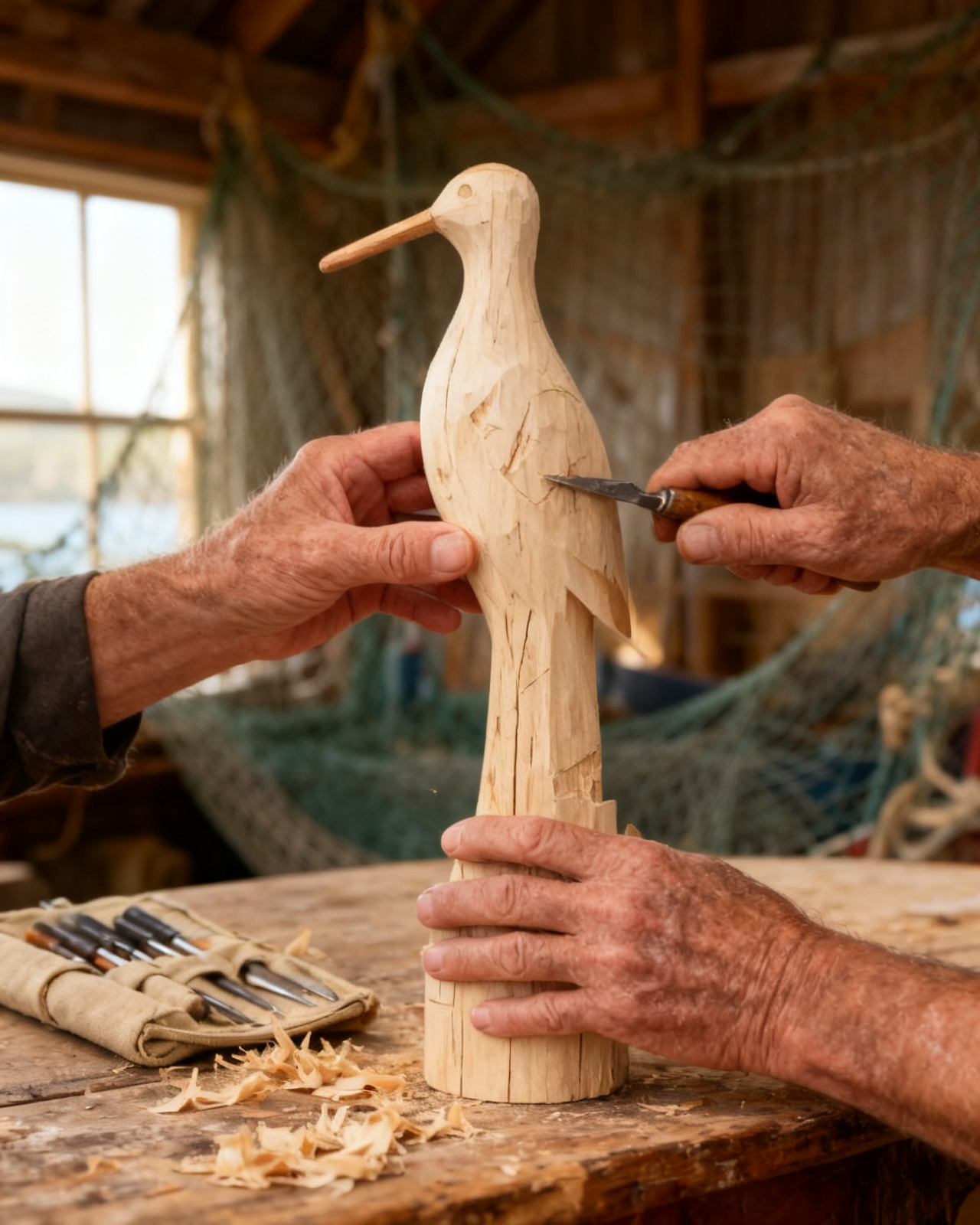
Jack Pengelly (78) in the net-loft above the harbour at Mevagissey, Cornwall. After forty winters at the bench, he is finishing the last birds he will ever carve.
Mevagissey, Cornwall. A still, bright morning in June, the harbour glassy and the boats nodding on the slack tide. Jack's net-loft is a low wooden room above the old fish cellars, one salt-fogged window looking down on the water. It smells of pitch, brine and the linseed oil he rubs into the wood. On the bench there is a chisel worn thin with sharpening, a coil of tarred rope, a margarine tub of shells and starfish gone chalky with drying, and two half-carved seabirds — tall, pale, long-legged, waiting for their second coat. Along the sill, a row of finished pairs, white-bodied with grey-green pencilled flanks, every one of them standing to attention like they're watching the boats come in.
Jack turns one of the little birds in his hands the way he has every winter for forty-odd years. He doesn't really look at it. He doesn't need to. His thumb reads the breast, the long slope of the neck, the slender leg he'll set into the driftwood. Then he sets it down, looks out at the water for a moment, and here — for the first time in the telling — he stops.
"It's not the carving," he says. Not bitter. Just plain. "I could do the carving in the dark, and most nights now I very near do. It's that I can't be up here anymore. I've a wife downstairs who needs me, and she needs me all the hours there are."
But this batch is different. It is the last.
A craft, and a carver, both reaching the end of the line
Jack is not alone, in two ways.
Heritage Crafts — the charity that keeps Britain's official Red List of Endangered Crafts — now lists dozens of traditional skills as "endangered" or "critically endangered", with too few working makers left to pass them on. The kind of work Jack does — a found piece of driftwood, a chisel, a length of rope and a lifetime's eye — is exactly the slow craft the list was made to mourn. "There were a dozen of us up and down this coast once," he says. "Carved decoys, gulls, the birds off the water, sold them on the quay to the summer people. I'm the last one of that lot still at it. And I'm finishing too."
He is finishing for a reason closer to home. His wife, Edith, has Alzheimer's disease — advanced now, and moving faster than either of them thought it would. Dementia is the leading cause of death in the United Kingdom; according to the Alzheimer's Society around 982,000 people are living with it, the great majority cared for at home, very often by a husband or wife in their seventies or eighties. Jack is one of them. He gave up the net-loft through the day to look after her full-time.
"She forgot my name in March," he says, and looks at the floor. "Knew my face. Couldn't find the name. That was the morning I knew I was done up here through the day."
"I've tried every way to keep it going"
He has, too.
He tried the early mornings, before she woke — "but she wakes frightened now if I'm not there." He tried bringing the work downstairs to the kitchen table, where he could keep an eye on her. "Chisels and a poorly woman don't mix. I gave that up quick." A neighbour's lad offered to sit with her of an afternoon so Jack could get up to the bench. "Good of him. But she wants me, see. Not a stranger. Me."
So it has come down to one hour. "She has a sleep after her dinner, middle of the day. About an hour, if I'm lucky. I come up here, I light the little stove, and I carve. One bird, an hour at a time." He nods at the two on the bench. "That's where these came from. An hour at a time, while she sleeps. When she goes into the home — and the doctor says that's coming — the hour goes with her. And then the carving stops for good."
What most people don't realise about a "hand-carved" seabird
And here is the thing most people never think about.
Almost every "coastal" or "nautical" bird you can buy today was never carved at all. "They're cast," Jack says. "Resin, poured into a rubber mould, sprayed by a machine that does a thousand a day, all identical. Or they're cut out of a sheet by a computer — same shape every time, down to the last feather." He picks one of his own off the sill. "Looks the same in a photograph. It's the opposite of this."
You can tell the moment you hold a pair, he says. A cast bird has no grain, because resin has no grain. "And it doesn't stand on anything real. Mine stand on driftwood I've picked off the beach myself — every piece shaped by the sea before ever I touched it. No two bits of driftwood in the world are the same. So no two of my pairs can be the same. It's not a thing I can repeat even if I wanted to."
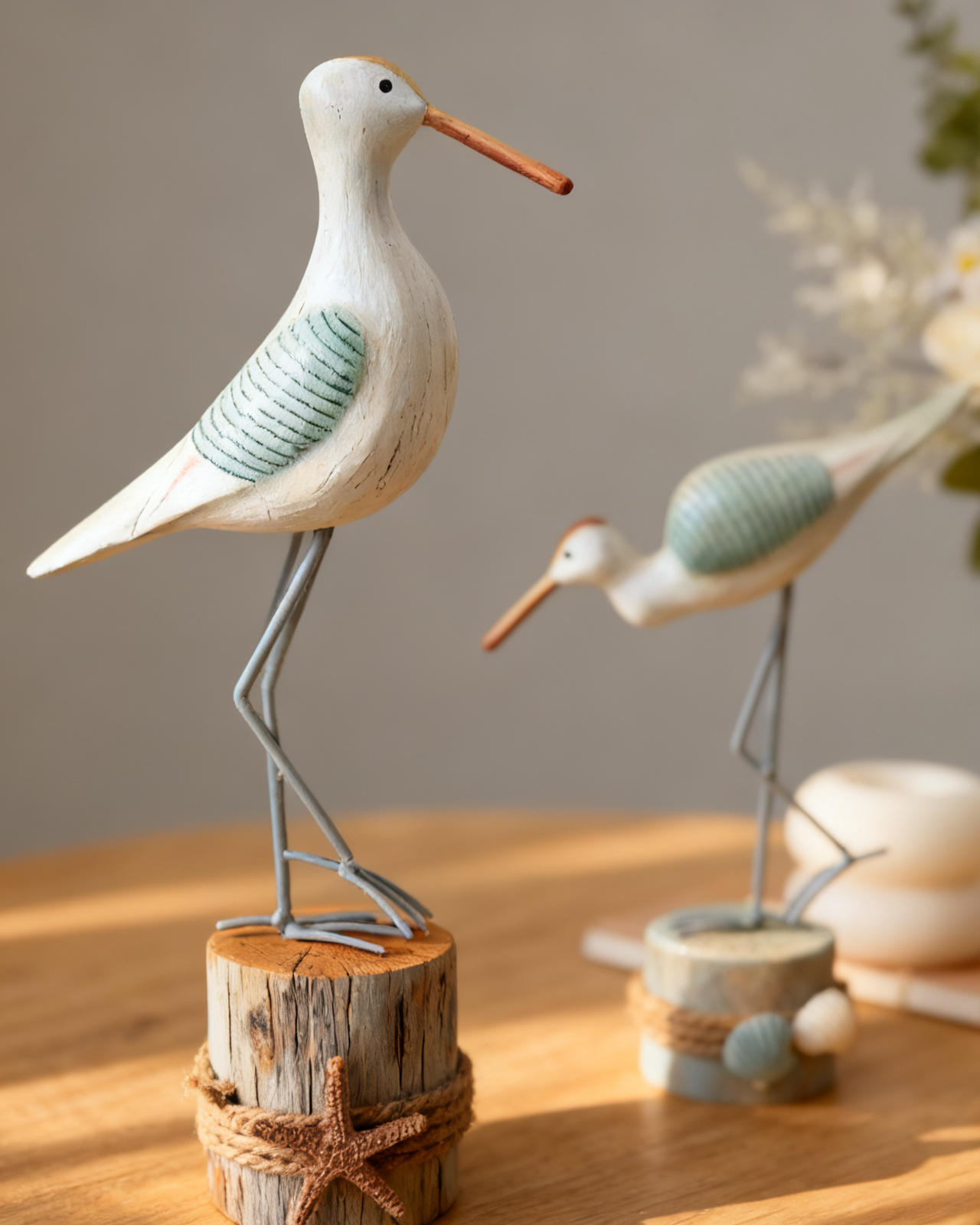
Made twice: once by the sea that silvered the driftwood over years, and once by Jack — the carving, the tarred rope, the shells he gathers off Pentewan sands.
But the wood, he says, is only half of it. "A bird like this is made twice. Once by the sea — that's the driftwood, sanded and split and silvered by ten years in the water. And once by me — the carving, the rope, the shells." He turns the post in the light so you can see the rope binding and the small starfish set into it. "I gather the shells off Pentewan sands of a morning. I tie the rope the way I tied it on the boats. Every leg, my Edith used to rig — she had small, clever hands. She can't now. So I do that too."
"That's the bit the machines have never managed," he says. "And it's the bit nobody can do once I've packed it in." He almost smiles. "The sea makes half of it and I make the other half, and between us there's only so many left in us."
How it started — selling birds on the quay
Jack did not set out to make ornaments.
He fished out of Mevagissey his whole working life, as his father did before him. In the off-season, when the weather shut the boats in, the men carved — decoys for the wildfowlers, gulls and shorebirds for the trippers — and sold them along the harbour wall to bring a few shillings in over the lean months. Jack learned it as a boy, a chisel too big for his hand. "It was Edith made me good at it, mind. I'd carve the bird, she'd rig the legs and tie the rope. We were a little factory of two, up in that loft, fifty years."
For decades it was just the pair of them and the birds going out — first along the quay, then by post across Cornwall, then far past it, two at a time. "I never advertised a day in my life. One pair went on a windowsill in a guesthouse and a woman wanted them, then her sister, then it was Christmas every year."
What sets Jack's seabirds apart
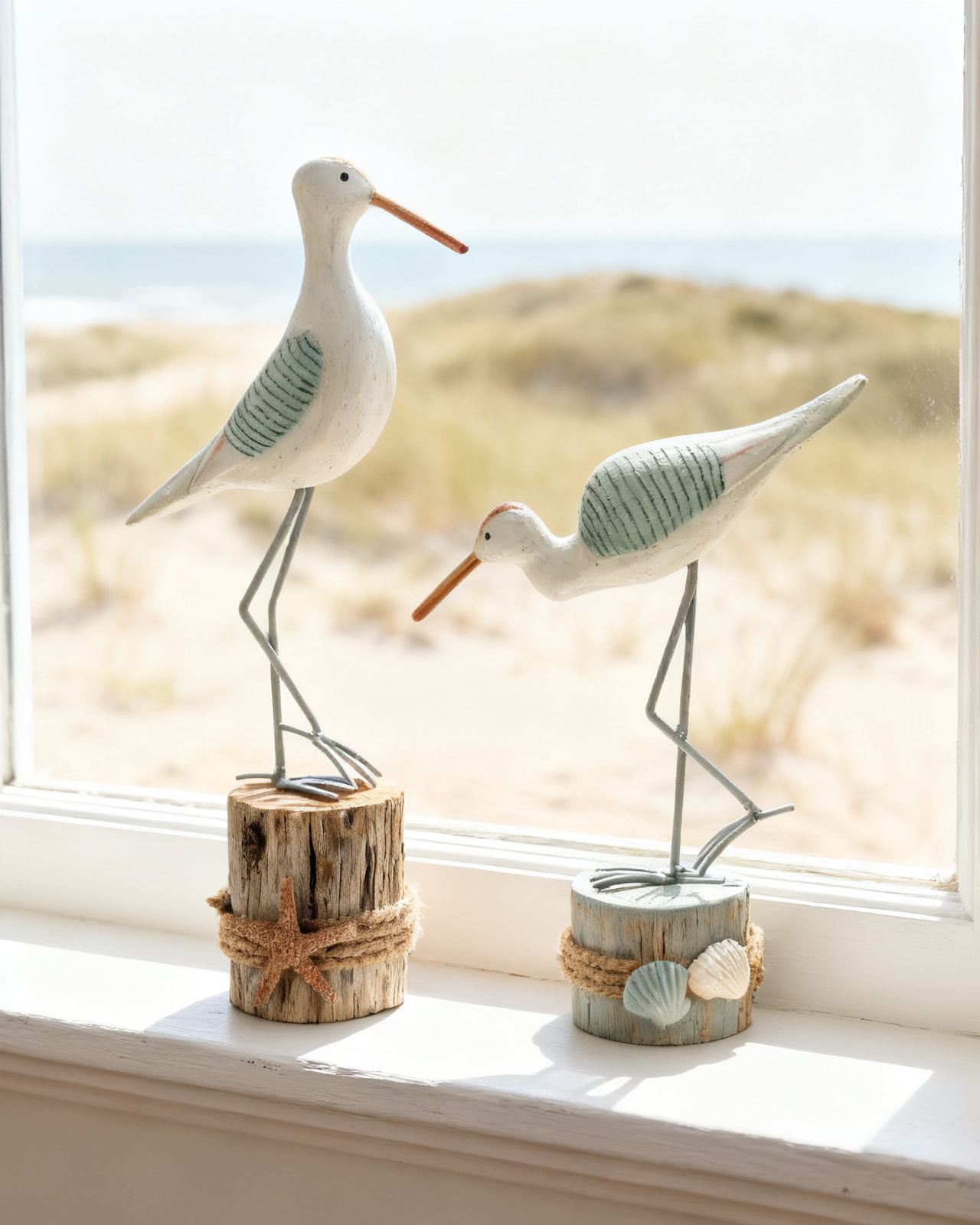
Each pair begins not with a block of timber but with a walk on the beach — two pieces of driftwood the sea shaped first.
Each pair begins not with a block of timber but with a walk on the beach. Jack chooses two pieces of sea-worn driftwood — split, silvered and softened by years in the water — and reads them for the bird already in them. The birds themselves are carved by hand, painted in weathered white with the soft grey-green pencilled flanks of a real shorebird, set on slender legs, and mounted on the driftwood with tarred rope and the shells and starfish he gathers himself. The taller bird stands about 33cm; its mate about 25.5cm; the pair weighs 460g.
- Mounted on real sea-worn driftwood — each post is a piece the sea shaped, split and silvered first; Jack only finds it and reads the bird in it. Never a moulded plastic base.
- Carved and painted by hand — weathered white bodies, grey-green pencil-striped flanks, slender legs. You can feel the chisel under the wing; no machine ever touched it.
- Rigged with tarred rope and real shells — the rope tied the way Jack tied it on the boats, the starfish and shells gathered by hand off Pentewan sands.
- One of one, every time — no two pieces of driftwood on earth are alike, so no two pairs can be. The set you choose exists nowhere else.
- Sold as a true pair — a taller bird and its mate, made to stand together as they were carved together. Not a single ornament dressed up as two.
- Ready to stand anywhere — a windowsill, a mantel, a shelf or a hall table. No feeding, no watering, no upkeep but the odd dust.
- From the final batch — every pair here was carved in the one hour a day Jack has left. When the bench closes, they are gone.
What people say about Jack's seabirds
"They stand on my kitchen windowsill looking out at nothing in particular and somehow they make the whole room feel like the seaside. The driftwood is the thing — properly old and silver, not a bit of it fake. You can tell a person made these."
— Marjorie T., 69, Falmouth
"I'll be honest, I half expected 'driftwood' to mean a sticker on some moulded base. It isn't. It's real beach wood, and the two birds aren't a matched pair off a machine — one's a touch taller, the rope's tied by hand. Properly made, the pair of them."
— Roger H., 72, Plymouth
"I bought them for my father, who cared for my mother through her dementia until the end. When I told him an old fisherman carves these in the one hour his wife sleeps, he had to put the phone down a minute. They sit where he can see them from his chair."
— Helen P., 58, Truro
The kind of gift someone keeps
What makes a pair of Jack's seabirds such a gift isn't only the carving. It is that they were made in stolen time — an hour a day, while a man's wife sleeps, by hands that are about to put the chisel down for good.
"When you give someone these two," he says, "you're not giving them an ornament off a shelf. You're giving them something a man sat and made, on driftwood the sea made first, in the last hour he had to give it. There won't be more once I'm down those stairs for good. The people who get a pair tend to understand that."
Secure one of the last pairs
Reserve one of the final hand-carved seabird pairs from Jack's bench — each on driftwood the sea shaped first — before he leaves the net-loft for good and they become part of history.
Limited quantity • While stocks last
Conclusion
Jack Pengelly's seabirds are not just decorative objects. They are a living piece of craft — carved by hand and mounted on driftwood the sea spent ten years shaping, by an old fisherman with a lifetime at the water, finished in the one quiet hour he has left before he gives it all up to care for the woman he married.
Some things deserve to be kept. Especially the last of them.
Thank you, Jack. For forty winters of birds — and for every hour you gave them while you could. 🕊️✨
Secure yours now → 100% money-back guarantee
DISCLAIMER:
The owner has a financial connection to the products and services promoted on this website. The product/service on this website may be offered by a company outside your local jurisdiction. Return costs are the customer's responsibility and additional charges, such as customs duties or taxes, may apply. Please read the returns policy and cancellation information for further details.
⚠ ADVERTISING | PAID ADVERTISEMENT
This article is a paid advertisement and not independent editorial reporting.
Representation notice
The story told in this article is a fictional advertising presentation. The person "Jack Pengelly", his wife, workshop, family, quotations and biographical details are invented and used solely for creative product presentation. They do not describe real people or real events. Images are illustrative.
Customer review notice
The customer opinions shown are example representations and describe possible experiences with the product. Individual experiences can vary. Names have been changed for privacy.
Product notice
The promoted product is a decorative pair of hand-carved wooden seabird ornaments on driftwood and may be ordered where available. Statements about "hand craft" and "hand-carved" refer to craft elements in the production and finishing process; materials are natural wood and driftwood and finishes may vary in grain, colour and markings from piece to piece. The product has no medical or therapeutic effect.
Availability notice
Information about quantity and availability is an estimate and may change. Availability is not guaranteed. The phrase "final batch" / "the last from his bench" refers to the current product batch.
Financial connection
The operator of this website has a financial connection to the advertised products and may receive commission for sales made through links on this page.
Notice for UK buyers
UK customers should review the seller information, delivery times and returns policy before purchasing. Depending on the seller's fulfilment location, customs duties, import VAT or handling fees may apply.
Returns
A returns policy applies as stated by the seller. Return shipping costs may be borne by the buyer unless otherwise required by applicable consumer law.
Provider information
Seller: Ecomcloud Trading LLP, 32 Kinburn Street, London, SE16 6DE, United Kingdom. Registration number: OC83840. Email: info@latestfinds.co.uk
© 2026 latestfinds. All rights reserved. This website contains sponsored content and advertising.