
Hand-Carved Wooden Fox — the maker's story
"I can rough out the whole fox by feel. It's the face — the look in it — that my hands are starting to refuse."
Why Iain MacAskill (69), a stalker and woodcarver in Torridon, is letting the last of his hand-carved foxes go.
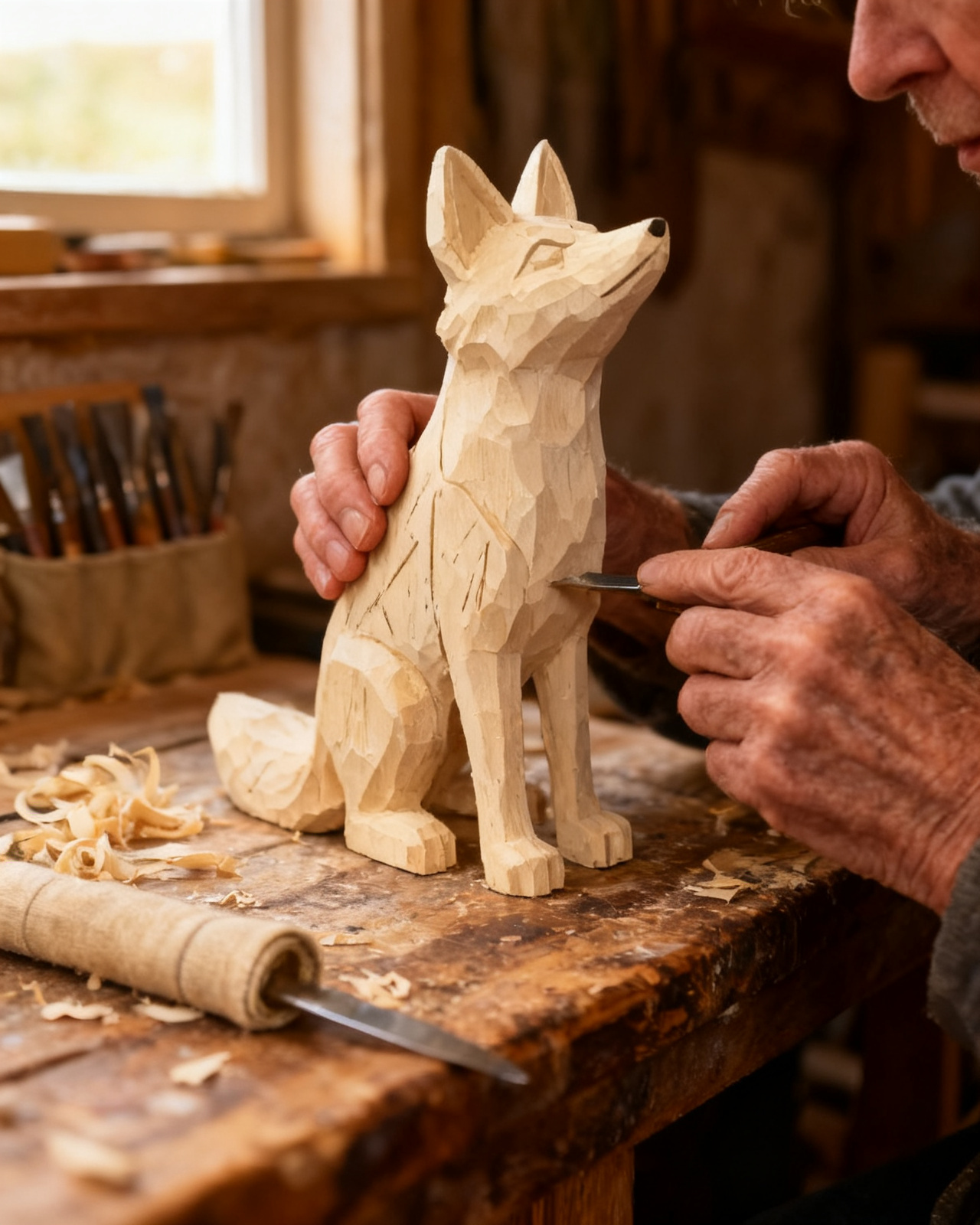
Iain MacAskill (69) in the bothy behind his croft at Torridon, Wester Ross. After thirty-five years on the hill and at the bench, he is carving the last foxes his hands will let him make.
Torridon, Wester Ross. A cold bright morning in June, the loch flat as slate and the great red hills of the Highlands still holding snow in their gullies. Iain's workshop is a stone bothy behind the croft, one window looking up the glen. It smells of cut wood, linseed oil and woodsmoke. On the bench there is a canvas roll of gouges worn thin with sharpening, a tin of paint gone tacky at the rim, a stub of pencil, and a half-carved fox no bigger than a real cub — pale, unfinished, waiting. Along the shelf, a row of finished foxes, rust-orange and white-chested, every one of them standing alert, one paw lifted, caught in the moment of looking.
Iain turns the little fox in his hands the way he has most mornings for thirty-five years. He does not need to look hard at the body. His thumb reads the line of the back, the brush of the tail, the set of the shoulder. Then he reaches for the finest gouge, the one he keeps for the face — and here, now, his hand stops, and will not quite do as it is told.
"This is the part that's going first," he says. Not bitter. Just plain. "The body, I could carve in the dark. But the face — the eyes, the muzzle, the little catch of life in it — that's fine work, and fine work needs a steady hand." He sets the gouge down before it can shake. "And my hands aren't mine the way they were a year ago."
But this batch is different. It is the last.
A craft, and a carver, both quietly running out of time
Iain is not alone, in two ways.
Heritage Crafts — the charity that keeps Britain's official Red List of Endangered Crafts — now lists dozens of traditional skills as "endangered" or "critically endangered", with too few working makers left to pass them on. Hand-carving of the kind Iain does — a single block, a knife, a gouge, an eye for an animal trained over a lifetime on the hill — is exactly the slow craft the list was made to mourn.
And motor neurone disease, the condition taking the strength from his hands, has no cure. According to the MND Association around 5,000 adults in the UK are living with it at any one time, and roughly a third die within a year of diagnosis. It attacks the nerves that drive the muscles, so the muscles waste and the movements go — grip, then the fine work, then more. The doctors gave Iain a year, maybe two. For most people it is the big things it steals first. For a carver, it is crueller and more precise than that. It comes for the very hands the whole craft is built on.
"You don't lose it all at once," he says. "It's the fine control that goes first. I can still swing an axe at a log. It's threading a fox's eye, the last quarter-hour of the work, that's getting away from me."
"I've tried everything to keep going"
He has, too.
A clamp rigged to hold the work dead still so his hand only has to guide, not grip. Mornings only, when the hands are freshest and the tremor least. His daughter sat beside him through the spring, blocking out bodies under instruction so he could save what strength he had for the faces. "She's good with her hands, my Cailean. But a fox's face isn't a thing you can be told. It's a hair's turn either way between alive and dead wood, and you either feel when it's right or you don't."
So he has carved on. The bodies are no trouble — his hands have shaped so many animals off these hills that they could nearly do it asleep, and most days now they very nearly do. It is only the last of the work that has begun to beat him. The face.
What most people don't realise about a "hand-carved" wooden fox
And here is the thing most people never think about.
Almost every "hand-carved wooden fox" you can buy today was never carved at all. "They're cast," Iain says. "Resin, poured into a rubber mould, sprayed by a machine that does a thousand a day for the garden-centre shelf. Or they're routed — a computer drives a cutter through cheap wood, same shape every time, down to the last hair." He picks one of his own off the shelf. "Looks the same in a photograph. It is the opposite of this."
You can tell the moment you hold one, he says. A cast fox has no grain, because resin has no grain. A routed fox has no tool marks, because no tool with a hand behind it ever touched it. "Run your thumb down the back of mine. You'll feel little flats, little ridges, where the gouge went. That's not a flaw. That's the carving. That's me."
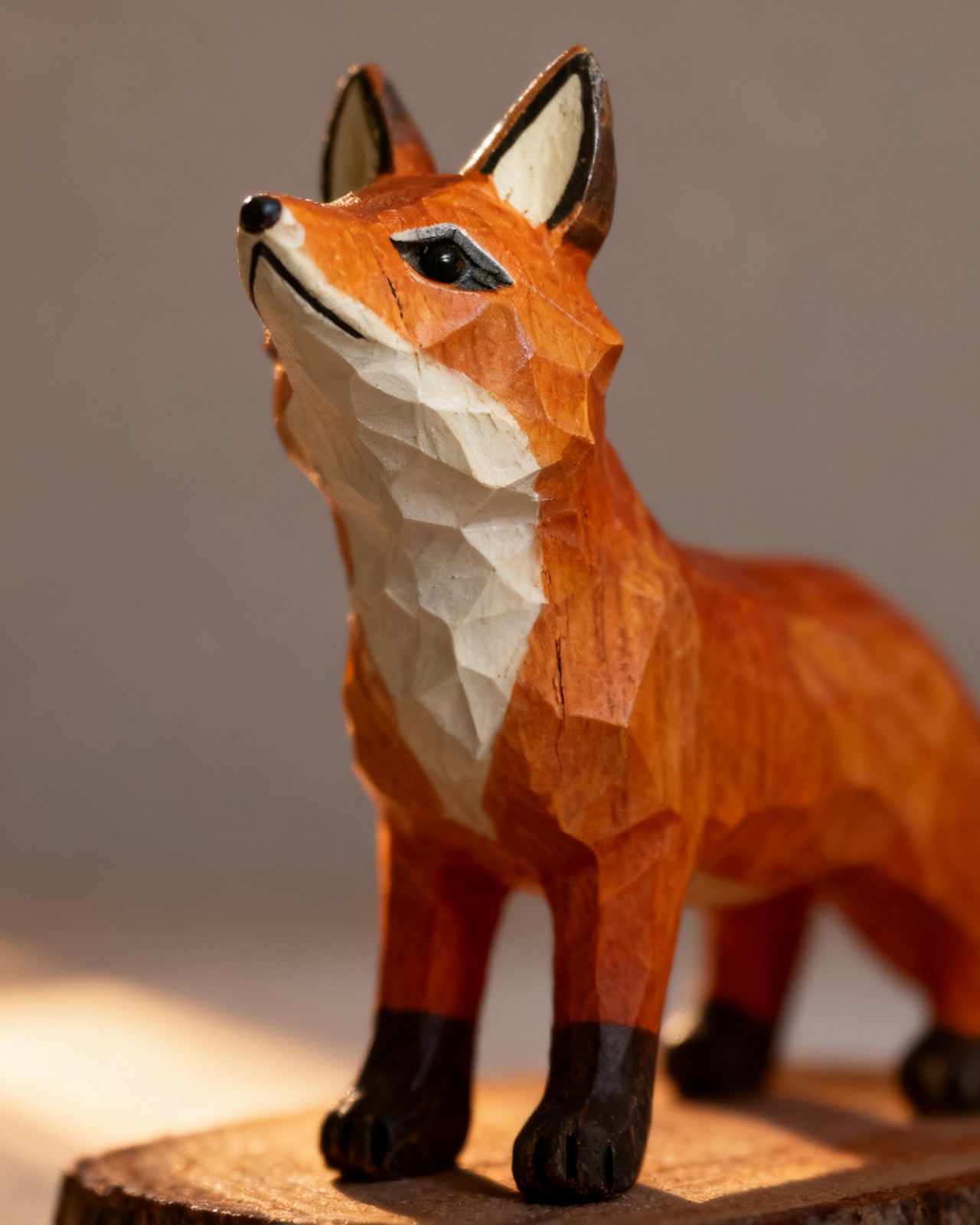
Run your thumb down the back: the little flats and ridges are where the gouge went. The face is cut last of all — by hand, by eye.
But the body, he says, is only half of it. "Any fool can get the shape of a fox. A fox is made twice. Once roughed out — that's the wood. And once in the face — that's the animal." He means it plainly. The last thing he does to each fox is cut the face by hand — the set of the eyes, the sharp little muzzle, the tilt of the head — at the exact angle that makes the creature seem to look back at you, alert, half a second from moving. A hair too wide and it looks tame. A hair too narrow and it looks dead. Miss by a fraction and the whole thing goes lifeless in your hand.
"That's the bit the machines have never managed," he says. "And that's the bit my hands are starting to refuse." He smiles, without much in it. "Thirty-five years I tracked these animals on the hill. Now it's their faces I'm running out of time to give."
How it started — on the hill, then at the bench
Iain did not set out to carve foxes.
He was a stalker and a gillie on the Torridon estate, the way his father had been — out on the hill in all weathers, tracking deer, watching fox and hare and ptarmigan move across the high ground until he knew them better than people. In the long winter evenings he began to carve the animals he had spent the day among — a fox, a hare, a hind — first for himself, then for the estate, then for the visitors who wanted to take a piece of the Highlands home.
"I never advertised a day in my life. One went on the windowsill at the estate lodge, and a guest wanted it, then another, then it was orders at Christmas." For decades it was just Iain — on the hill by day, at the bench by night — and the carved animals going out across Scotland, then far past it, one at a time.
What sets Iain's foxes apart
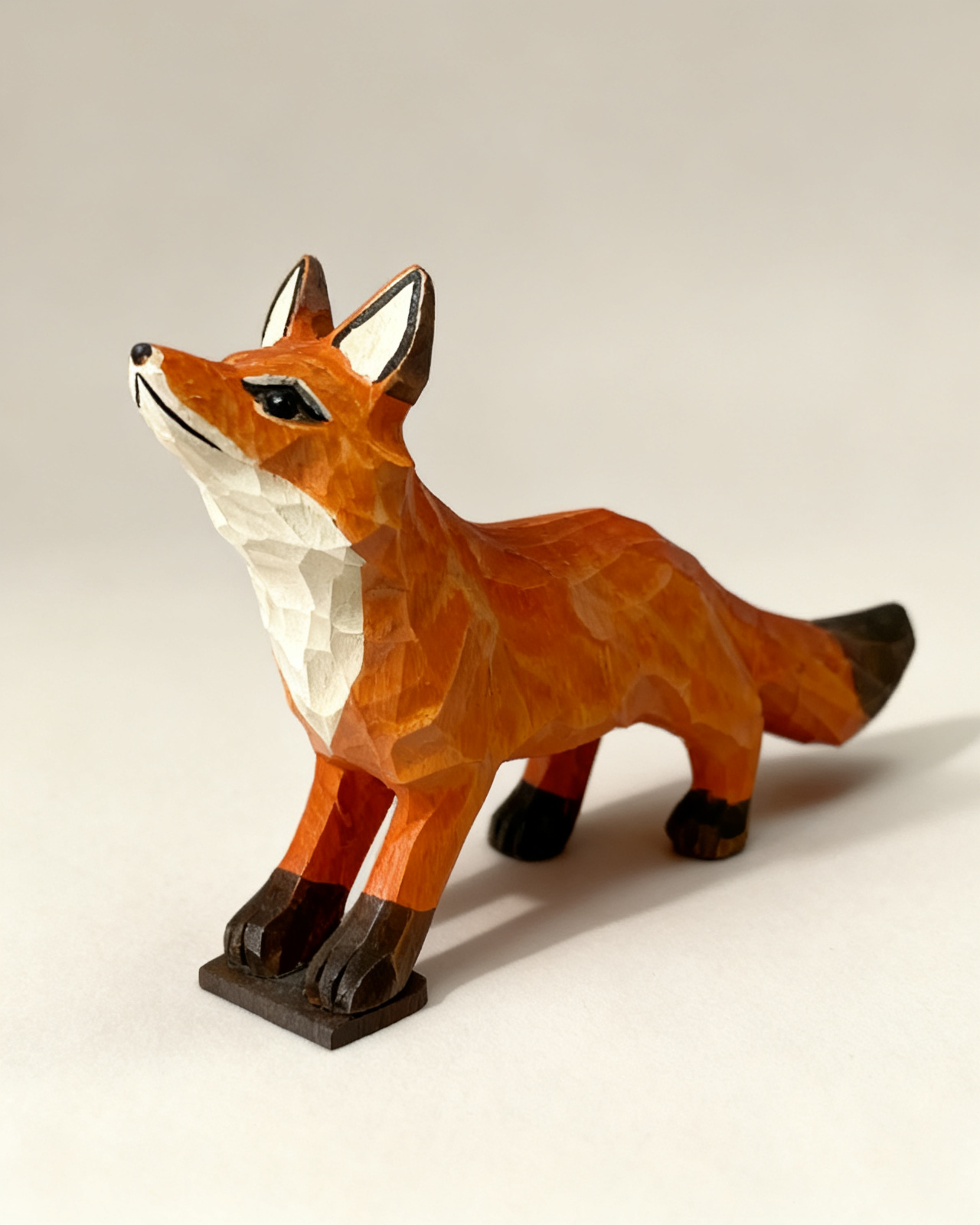
Each fox begins as a single block of seasoned wood — and ends with a face cut true by hand.
Each fox begins as a single block of seasoned wood — never glued, never joined. It is cut down with gouge and knife until the back, the brush of the tail and the lifted paw feel right in the hand; then the face is cut by hand and painted by hand — the rust-orange coat, the white chest, the dark legs and the sharp watching face of a Highland fox. And last of all, the look in it.
- Carved from a single block of seasoned wood — never cast in resin, never routed by machine, never glued. The grain runs through the whole fox the way it ran through the tree.
- Hand-cut with gouge and knife — you can feel the tool marks down the back and along the flank. That texture is the proof no machine ever touched it.
- The face cut by hand — the set of the eyes, the muzzle and the alert tilt of the head, worked by eye until the fox seems to look back at you. The part no machine has managed — and the part Iain's hands can no longer be sure of.
- One of one, every time — a knife in a hand cannot repeat itself. The turn of the head, the lift of the paw, the watchful face: yours exists nowhere else.
- Hand-painted in a Highland fox's colours — rust-orange coat, white chest, dark legs, softly worked so it looks as though it has just stepped out of the bracken.
- Stands ready to place — alert, one paw lifted; at home on a windowsill, a shelf or a mantel. No feeding, no upkeep, no fuss.
- From the final batch — every fox here still carries a face Iain cut himself. When they are gone, they are gone.
What people say about Iain's foxes
"It's the face that does it. It catches you from right across the room, as if it's about to turn its head and trot off. My husband swears it's watching us. A real thing in a house full of plastic."
— Christine M., 66, Inverness
"I'll be honest, I half expected 'carved' to mean a machine somewhere. It doesn't. You can feel the little ridges where the tool went, and no two on the website were alike. Properly made."
— Alan P., 70, Perth
"I bought it for my father, who's not been well himself. When I told him the man who carved it has motor neurone disease and is making the last of them, he held it a long while and went quiet. It means something."
— Lorna D., 58, Fort William
The kind of gift someone keeps
What makes one of Iain's foxes such a gift isn't only the carving. It is the face that was cut by a hand that is running out of time to cut them.
"When you give someone one of these," he says, "you're not giving them an ornament off a shelf. You're giving them something a person sat and made, right down to the look on its face. There won't be more once my hands go. The people who get one tend to understand that."
Secure one of the last foxes
Reserve one of the final hand-carved foxes from Iain's bench — each with a face he cut himself — before his hands go and they become part of history.
Limited quantity • While stocks last
Conclusion
Iain MacAskill's fox is not just a decorative object. It is a living piece of craft — carved by hand from a single block of seasoned wood, by a man with a lifetime on the hill and at the bench, and finished with a face cut true by a hand that may not get to cut many more.
Some things deserve to be kept. Even when the hands that made them are failing.
Thank you, Iain. For a lifetime on the hill — and for every fox you ever brought to life in the wood. 🦊✨
Secure yours now → 100% money-back guarantee
DISCLAIMER:
The owner has a financial connection to the products and services promoted on this website. The product/service on this website may be offered by a company outside your local jurisdiction. Return costs are the customer's responsibility and additional charges, such as customs duties or taxes, may apply. Please read the returns policy and cancellation information for further details.
⚠ ADVERTISING | PAID ADVERTISEMENT
This article is a paid advertisement and not independent editorial reporting.
Representation notice
The story told in this article is a fictional advertising presentation. The person "Iain MacAskill", his workshop, family, quotations and biographical details are invented and used solely for creative product presentation. They do not describe real people or real events. Images are illustrative.
Customer review notice
The customer opinions shown are example representations and describe possible experiences with the product. Individual experiences can vary. Names have been changed for privacy.
Product notice
The promoted product is a decorative hand-carved wooden fox ornament and may be ordered where available. Statements about "hand craft" and "hand-carved" refer to craft elements in the production and finishing process; materials are natural wood and finishes may vary in grain, colour and markings from piece to piece. The product has no medical or therapeutic effect.
Availability notice
Information about quantity and availability is an estimate and may change. Availability is not guaranteed. The phrase "final batch" / "the last from his bench" refers to the current product batch.
Financial connection
The operator of this website has a financial connection to the advertised products and may receive commission for sales made through links on this page.
Notice for UK buyers
UK customers should review the seller information, delivery times and returns policy before purchasing. Depending on the seller's fulfilment location, customs duties, import VAT or handling fees may apply.
Returns
A returns policy applies as stated by the seller. Return shipping costs may be borne by the buyer unless otherwise required by applicable consumer law.
Provider information
Seller: Ecomcloud Trading LLP, 32 Kinburn Street, London, SE16 6DE, United Kingdom. Registration number: OC83840. Email: info@latestfinds.co.uk
© 2026 latestfinds. All rights reserved. This website contains sponsored content and advertising.