
Hand-Carved Coastal Seabirds — the maker's story
"I can carve a bird with my eyes shut. It's the bench I'm losing — they've sold the shed out from under me."
Why Donald Reid (74), a boat-builder in the East Neuk of Fife, is letting the last of his hand-carved seabirds go.
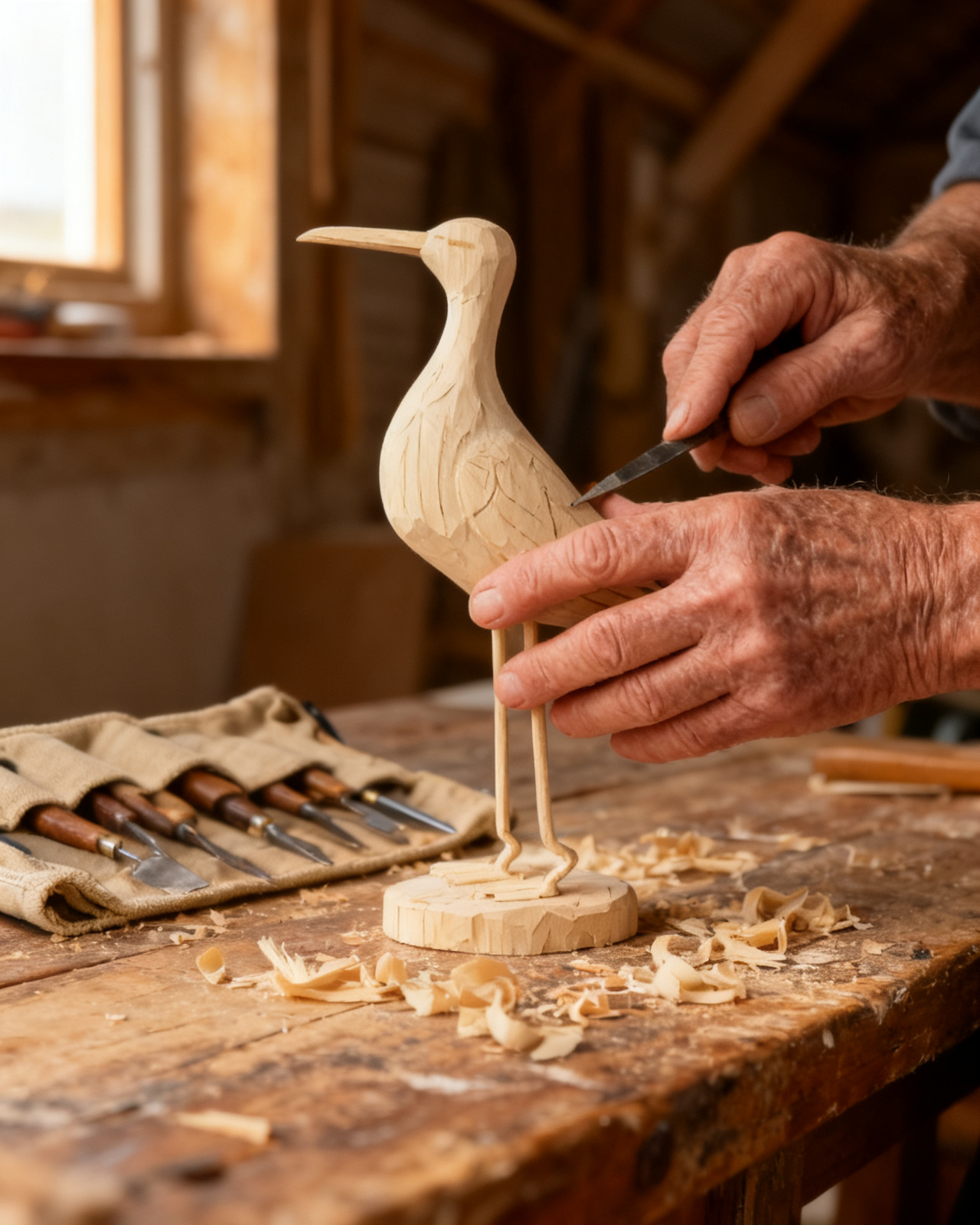
Donald Reid (74) in the harbour boat-shed at Anstruther, Fife. After more than forty years at the bench, he is carving the last of his seabirds on a bench he no longer owns.
Anstruther, the East Neuk of Fife. A cold bright morning off the North Sea, the tide pushing in past the harbour wall. Donald's workshop is the old boat-shed down on the front, tarred black, one wide door open to the water. It smells of pitch, sawn pine and salt. On the bench there is a canvas roll of chisels worn thin with sharpening, a coil of soft black wire, a tin of paint gone tacky at the rim, and a half-shaped bird — a tall shorebird, long in the leg, pale and unfinished, waiting. Along the sill stand the finished ones, paired off: white breasts, olive-khaki wings tipped with black, every one of them facing out to the firth.
Donald turns the rough little body in his hands the way he has every morning for forty-odd years. He doesn't really look at it. He doesn't need to. His thumb reads the breast, the set of the folded wing, the long line of the back. Then he sets it down, glances up at the wide door and the water beyond it, and here, for the first time, he stops.
"It's not my hands that have gone," he says. Not bitter. Just plain. "The hands are fine. I could carve the whole thing in the dark." He nods at the shed around him, the rafters, the tarred boards. "It's this. They've sold the shed. Holiday flats. Keys go back at the end of the month."
But this batch is different. It is the last.
A craft, and a workshop, both quietly going under
Donald is not alone, in two ways.
Heritage Crafts — the charity that keeps Britain's official Red List of Endangered Crafts — now lists dozens of traditional skills as "endangered" or "critically endangered", with too few working makers left to pass them on. Hand-carving of the kind Donald does — a block of offcut, a knife, a chisel, an eye for a bird trained over decades — is exactly the slow craft the list was made to mourn.
And the working harbours that carried men like him are going the same way. Along the Fife coast, the old net-lofts, sail-stores and boat-sheds that once lined every working quay have been sold off one by one — turned into holiday lets and second homes as the fishing dwindled. For most people that is a view from the harbour wall. For a man with a lifetime's work on a single bench, it is more precise than that. It takes away the one place the whole craft was built in.
"A boat-shed's not just walls," he says. "It's the light off the water, the room to swing a plank, somewhere dry to leave the glue overnight. You don't get that in a lock-up on an industrial estate. And anywhere I could afford, I cannae." He says it flatly, the Fife in it. "Forty years on this bench. And it was never mine to keep."
"I've tried everything to stay on the water"
He has, too.
He went to the council about the empty store by the lifeboat house — "spoken for." He asked at two of the bigger yards up the coast about a corner of a shed — "kind enough, but they've no room, and it's an hour each way." His son offered the garage at the back of the house in Cupar, inland. "Good of him. But it's the wrong place. A shorebird wants to be made within sound of the sea. Make it in a garage off a bypass and somehow you can tell. The bird knows."
So he has carved on, down on the front, against the clock. The bodies are no trouble — his hands have shaped so many that they could do it blind, and most mornings now they very nearly do. It is the rest of it that's beaten him: the room, the door, the water, the bench. The shed.
What most people don't realise about a "hand-carved" seabird
And here is the thing most people never think about.
Almost every "hand-carved" coastal bird you can buy today was never carved at all. "They're cast," Donald says. "Resin, poured into a rubber mould, the same bird a thousand times over, sprayed by a machine. Or the legs are a bent bit of stiff steel they jam in the base so the thing'll stand for a photo." He picks one of his own off the sill. "Looks the same in a picture. It's the opposite of this."
You can tell the moment you pick one up, he says. A cast bird has no grain, because resin has no grain. It has no tool marks, because no tool with a hand behind it ever touched it. "Run your thumb up the back of mine. You'll feel the little flats where the chisel went. That's not a fault. That's the carving. That's me."
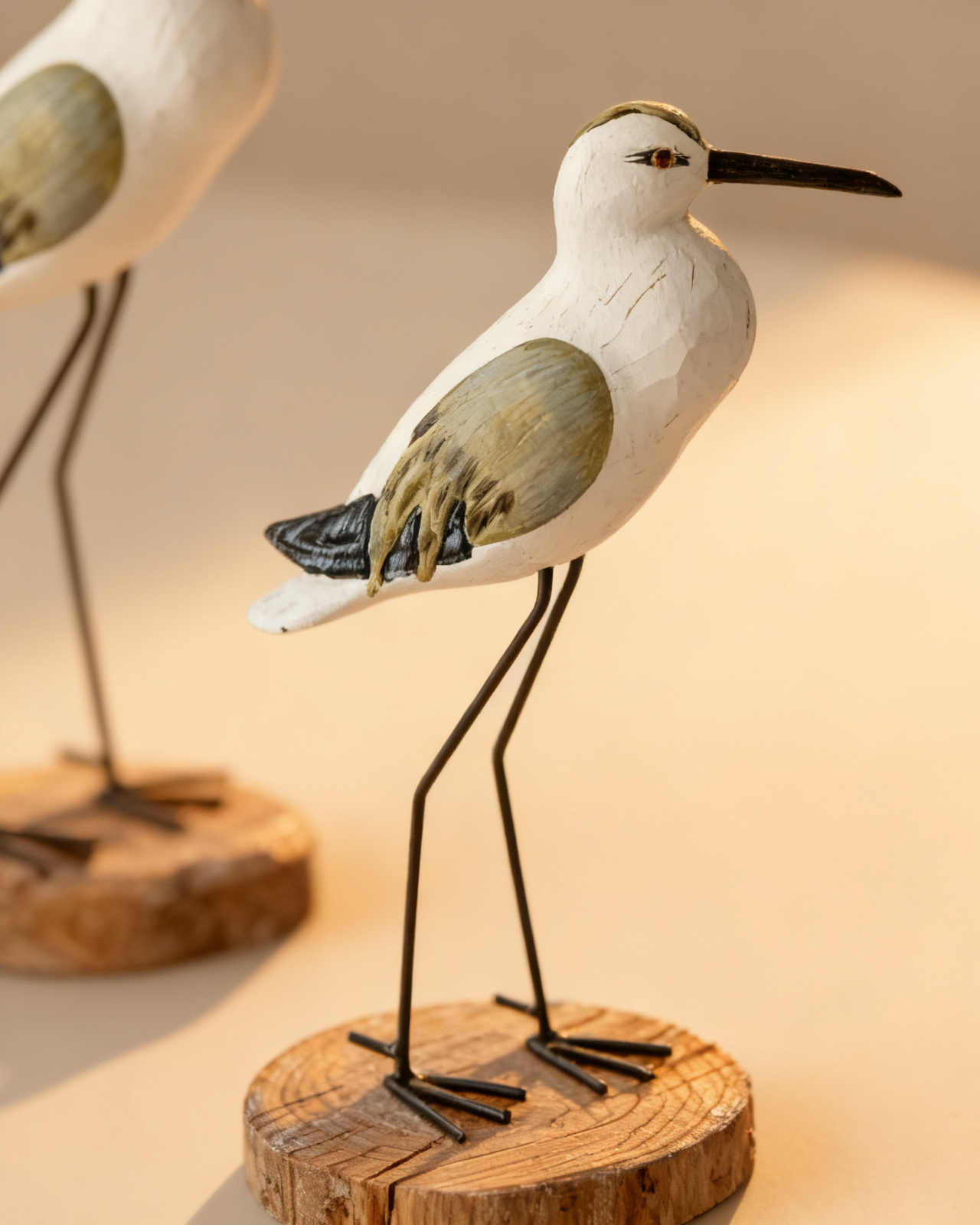
Run your thumb up the back: the little flats are where the chisel went. Each long leg is bent by hand from soft wire, a fraction at a time, until the bird stands true.
But the carving, he says, is only half of it. "A shorebird's all about the legs. Get the legs wrong and it's a duck on stilts." He means it plainly. After the body is cut and painted, he bends each leg by hand from soft black wire — two long wading legs — and works them, a fraction at a time, against the weight of the bird, until it stands true on its own on the round wood base. No prop, no glue blob, no jamming a stiff spike in to fake it. "Every bird's a different weight, so every pair of legs is bent different. You're balancing the thing by feel. That's the bit the moulds have never managed."
He turns the bird so it stands square on the bench, level, looking out the door. "Two coats of paint, mixed by hand — the natural one, white and khaki and the black tips, like the real thing off the mud out there. And the blue, a soft coastal blue, for them that wants a pair with a bit of the sea in it." He sets it down. "When the shed goes, the bench goes, and the legs stop getting bent. That's the end of it."
How it started — boats first, birds after
Donald did not set out to make ornaments.
He built boats. Clinker dinghies, repairs, the slow patient joinery of a working harbour, forty years of it. The birds began in the lean months, the way they always had on this coast — something to do with the offcuts when the boat-work was thin. "You'd a box of good pine ends too small for anything and too good to burn. So you carved. Gulls first. Then the waders off the mud — the long-legged ones, the avocets, the godwits. The summer folk liked them."
For years it was just a sideline. One stood in the window of a gallery up the road, and somebody wanted it, then somebody else, then it was Christmas orders from down south. "I never advertised in my life. They just went out, one pair at a time, all along the coast." Thirty-odd years of it — Donald at the bench in the boat-shed, and the birds going out across Fife, then far past it.
What sets Donald's seabirds apart
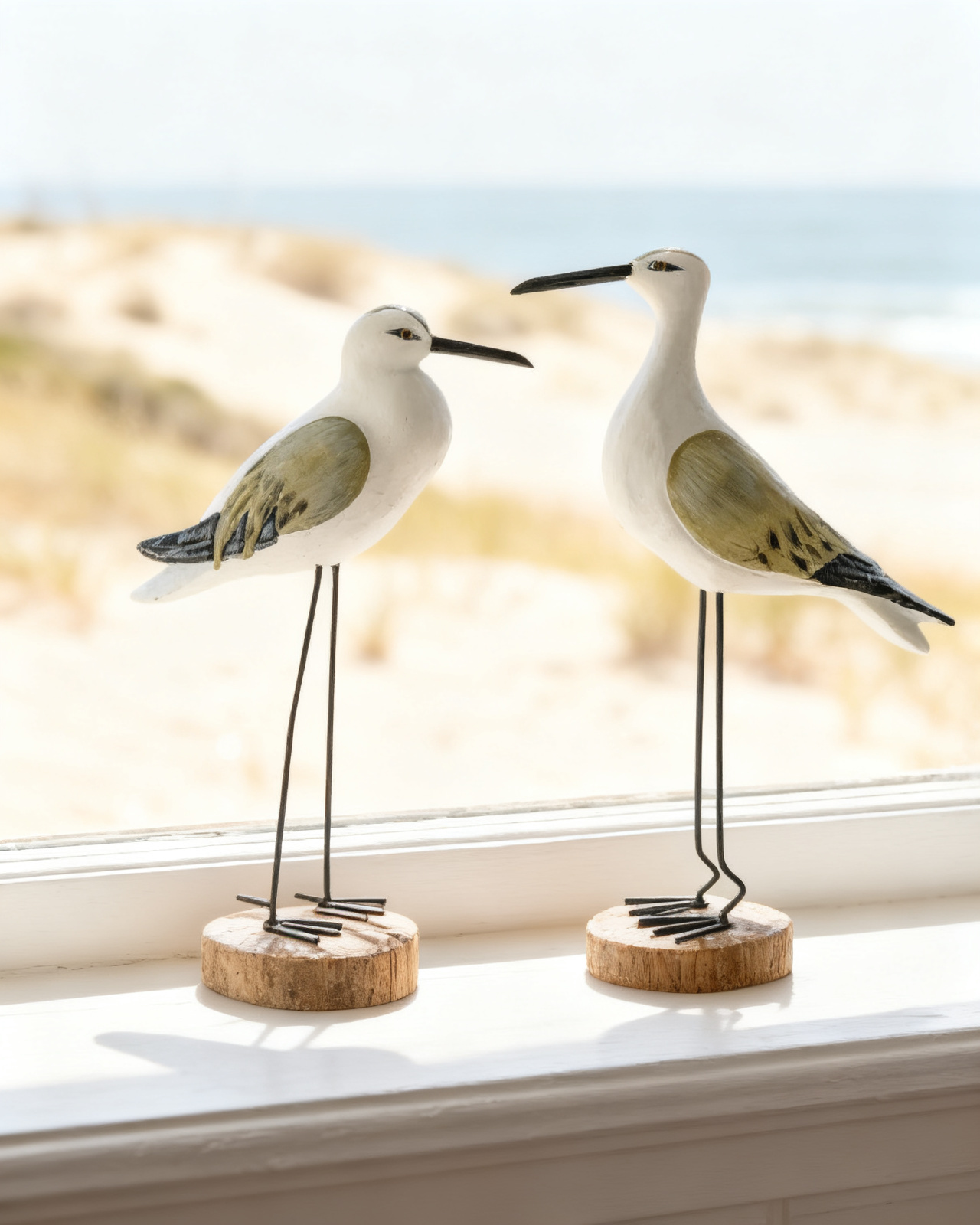
Each pair begins as offcuts of seasoned boat-pine — and ends stood true on legs bent by hand, one at a time.
Each bird begins as an offcut of seasoned pine — boat wood, never wasted. It is cut down with knife and chisel until the breast, the folded wing and the long back feel right in the hand; then painted by hand in two coats, and last of all stood up on legs bent one at a time from soft black wire until it balances true on its round wood base. Sold as a pair — and offered in two hand-mixed colourways.
- Carved by hand from seasoned pine offcuts — boat wood, never cast in resin, never routed by machine. The grain runs through the bird the way it ran through the plank.
- Hand-cut with knife and chisel — you can feel the little flats and tool marks up the back and under the wing. That texture is the proof no machine ever touched it.
- Balanced on hand-bent wire legs — each long leg shaped by hand, a fraction at a time, against the weight of that particular bird, so it stands true on its own. Not a stiff steel spike jammed in to fake it.
- Two hand-mixed colourways — the natural, a white breast with olive-khaki wings and black wing-tips, like the waders off the mud; or a soft coastal blue, for a pair with the sea in it.
- One of one, every pair — a knife in a hand cannot repeat itself, and no two pairs of legs are bent quite the same. The set of the head, the lean of the body: yours exists nowhere else.
- Stood ready to perch — each bird on its own round wood base; at home on a windowsill, a shelf or a mantel. No feeding, no watering, no winter shelter.
- From the final batch — every pair here was carved and balanced on Donald's own bench, in the boat-shed, before the keys go back. When they are gone, they are gone.
What people say about Donald's seabirds
"The legs are the thing. They actually stand — properly stand, on their own, no stand, no stick. You can see they've been bent by hand because the pair lean ever so slightly different. A real thing in a house full of plastic."
— Catriona M., 64, Dundee
"I'll be honest, I half expected 'hand-carved' to mean a mould somewhere. It doesn't. You can feel the chisel marks up the back, and the two birds aren't identical. Properly made — and they look right by the window with the sea behind them."
— Iain F., 69, North Berwick
"I bought the blue pair after I read he'd lost his workshop — the boat-shed sold off for holiday flats. When they arrived I understood it. You're not buying an ornament. You're buying the last of something. They sit on my mother's sill and she tells everyone the story."
— Morag T., 58, Perth
The kind of gift someone keeps
What makes one of Donald's pairs such a gift isn't only the carving. It is that it came off a bench he's about to lose, balanced by a hand that's running out of room to balance them.
"When you give somebody a pair of these," he says, "you're not giving them something off a shelf in a shop. You're giving them two birds a man sat and made, right down to bending the legs so they'd stand. There'll be no more once the shed's gone. The folk who get a pair tend to understand that."
Secure one of the last pairs
Reserve one of the final pairs of hand-carved seabirds from Donald's bench — each pair balanced on legs he bent himself — before the boat-shed goes and they become part of history.
Limited quantity • While stocks last
Conclusion
Donald Reid's seabirds are not just decorative objects. They are a living piece of craft — carved by hand from boat-wood offcuts, painted by hand in two coastal colours, and stood true on legs bent one at a time by a man with a lifetime at the bench, in the last weeks he'll have a bench to stand them on.
Some things deserve to be kept. Even when the place that made them is sold from under it.
Thank you, Donald. For forty years of boats and birds — and for every leg you ever bent true. 🕊️✨
Secure yours now → 100% money-back guarantee
DISCLAIMER:
The owner has a financial connection to the products and services promoted on this website. The product/service on this website may be offered by a company outside your local jurisdiction. Return costs are the customer's responsibility and additional charges, such as customs duties or taxes, may apply. Please read the returns policy and cancellation information for further details.
⚠ ADVERTISING | PAID ADVERTISEMENT
This article is a paid advertisement and not independent editorial reporting.
Representation notice
The story told in this article is a fictional advertising presentation. The person "Donald Reid", his workshop, family, quotations and biographical details are invented and used solely for creative product presentation. They do not describe real people or real events. Images are illustrative.
Customer review notice
The customer opinions shown are example representations and describe possible experiences with the product. Individual experiences can vary. Names have been changed for privacy.
Product notice
The promoted product is a decorative hand-carved wooden bird ornament and may be ordered where available. Statements about "hand craft" and "hand-carved" refer to craft elements in the production and finishing process; materials are natural wood and finishes may vary in grain, colour and markings from piece to piece. The product has no medical or therapeutic effect.
Availability notice
Information about quantity and availability is an estimate and may change. Availability is not guaranteed. The phrase "final batch" / "the last from his bench" refers to the current product batch.
Financial connection
The operator of this website has a financial connection to the advertised products and may receive commission for sales made through links on this page.
Notice for UK buyers
UK customers should review the seller information, delivery times and returns policy before purchasing. Depending on the seller's fulfilment location, customs duties, import VAT or handling fees may apply.
Returns
A returns policy applies as stated by the seller. Return shipping costs may be borne by the buyer unless otherwise required by applicable consumer law.
Provider information
Seller: Ecomcloud Trading LLP, 32 Kinburn Street, London, SE16 6DE, United Kingdom. Registration number: OC83840. Email: info@latestfinds.co.uk
© 2026 latestfinds. All rights reserved. This website contains sponsored content and advertising.