
Hand-Painted Wooden Cardinal — the maker's story
"I can paint that red with my eyes shut. I just haven't got many more in me."
Why Bernard Lowe (77), a Potteries paint-shop hand, is letting the last of his hand-painted birds go.
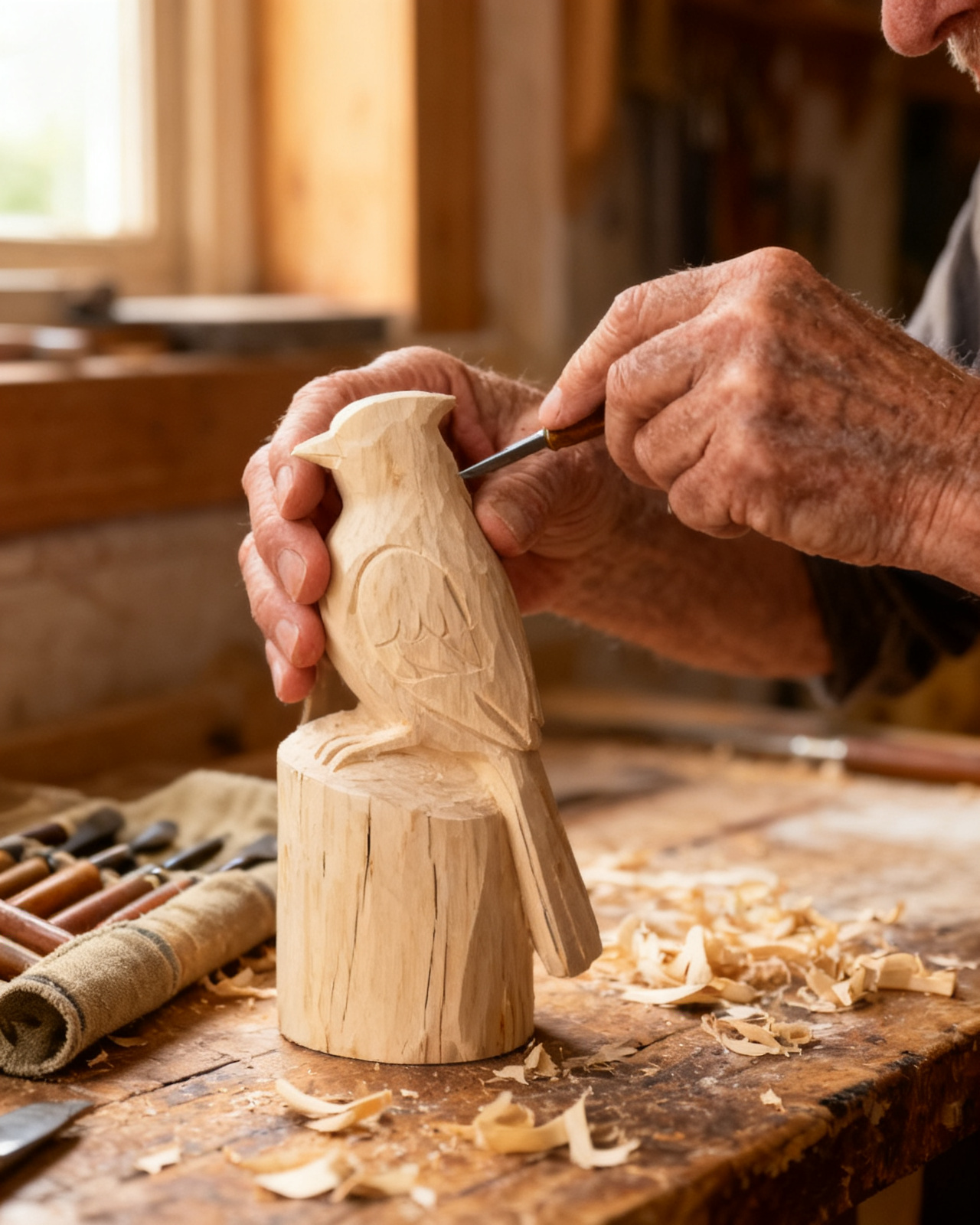
Bernard Lowe (77) at the kitchen table in Stoke-on-Trent. Fifty years a paint-shop hand in the Potteries, he is finishing the last birds his hands will ever paint — and red was always his colour.
Stoke-on-Trent, a warm afternoon in June. Bernard does his painting at the kitchen table now, not the works — a folded tea towel under his elbow, the good light coming in over the sink. On the oilcloth there is a jam jar of brushes gone soft with use, a saucer of deep red he has mixed by eye, a smaller one of black, and a row of little carved birds waiting their turn: pale, bare wood, blank as yet. Behind him, on the windowsill, the ones he has already finished — each a clean flare of red with a crisp black mask, looking out at the garden.
Bernard picks up a bare bird and turns it once in his fingers. He does not look at the body. The carver does the body; that is not his part. His part is the colour. He loads the brush, tips the bird to the light, and lays the first stroke of red down the back in one long pull — no hesitation, no going over it twice.
"Fifty years I've been laying red onto things," he says. "Cups, plates, a million of them. You stop thinking about it after a while. The hand just knows." He sets the bird down to take. "Trouble is, the hand's about the only part of me still behaving itself."
But this batch is different. It is the last.
A craft, and a painter, both quietly running out of time
Bernard is not alone, in two ways.
Heritage Crafts — the charity that keeps Britain's official Red List of Endangered Crafts — now lists dozens of traditional skills as "endangered" or "critically endangered", with too few working makers left to pass them on. Freehand decorative painting of the kind Bernard does — a loaded brush, a steady hand, an eye for colour trained over a working lifetime — is exactly the slow skill the list was made to mourn. The Potteries once employed thousands of paintresses and paint-shop hands. Today you could fit the ones left who can do it freehand into a single room.
And Bernard himself is running out of time in the plainest way there is. In the spring the doctors found a cancer of the pancreas, and were honest with him about what that means. Months, they said, not years. He took it the way he takes most things — quietly, and then back to the table.
"I'm not going to sit and mope about it," he says. "I've had a good run. Seventy-seven. Most of it doing something with my hands that I was actually any good at. Not everybody gets that." He dips the brush again. "But when they tell you a thing like that, you start counting. And I'd rather spend what's left finishing these than staring at the wall."
"I tried to teach it. It doesn't pass on in an afternoon"
He did try to hand it on.
His daughter sat with him a few evenings, brush in hand, willing as anything. A young lad from down the road came round twice. "Good kids, both of them. But the red beat them, same as it beats everyone at first." A factory bird gets its colour sprayed or printed — flat, even, the same on every single one. Bernard's red is laid on by hand, and that is a different thing entirely. "You've got to feel how much paint's on the brush. Too little and it goes patchy and thin. Too much and it pools, runs, dries with a tide-mark. And the mask — the black round the face — that's the one that finishes them or ruins them. A whisker off and the whole bird looks wrong, and you can't say why, you just know."
So he has carried on doing it himself. The body's no trouble; the carver sends them through bare and Bernard's hands could colour them in the dark. It is the standard he won't drop. "I'm not putting my name to a bird with a wobbly mask. Rather not finish it at all."
What most people don't realise about a "hand-painted" wooden bird
And here is the thing most people never think about.
Almost every "hand-painted" wooden bird you can buy today was never hand-painted at all. "It's sprayed," Bernard says. "Hung on a line, blasted with a gun, baked, done — thousands a day. Or it's a printed transfer, a sticker near enough, wrapped round the wood and sealed over." He picks up a finished one off the sill. "Looks all right in a little photograph. Stand it next to one of mine and you'll never be fooled again."
You can tell the moment you hold one, he says. A sprayed bird has colour with no depth — flat, dead-even, the same dull red as the next ten thousand. A printed one has a faint sheen and a join where the transfer meets, if you know to look. "Mine's brushed. Get it in the light and tilt it — you'll see where the brush went, little long marks in the red, the colour deeper here, catching there. That's not a fault. That's a hand. That's me."
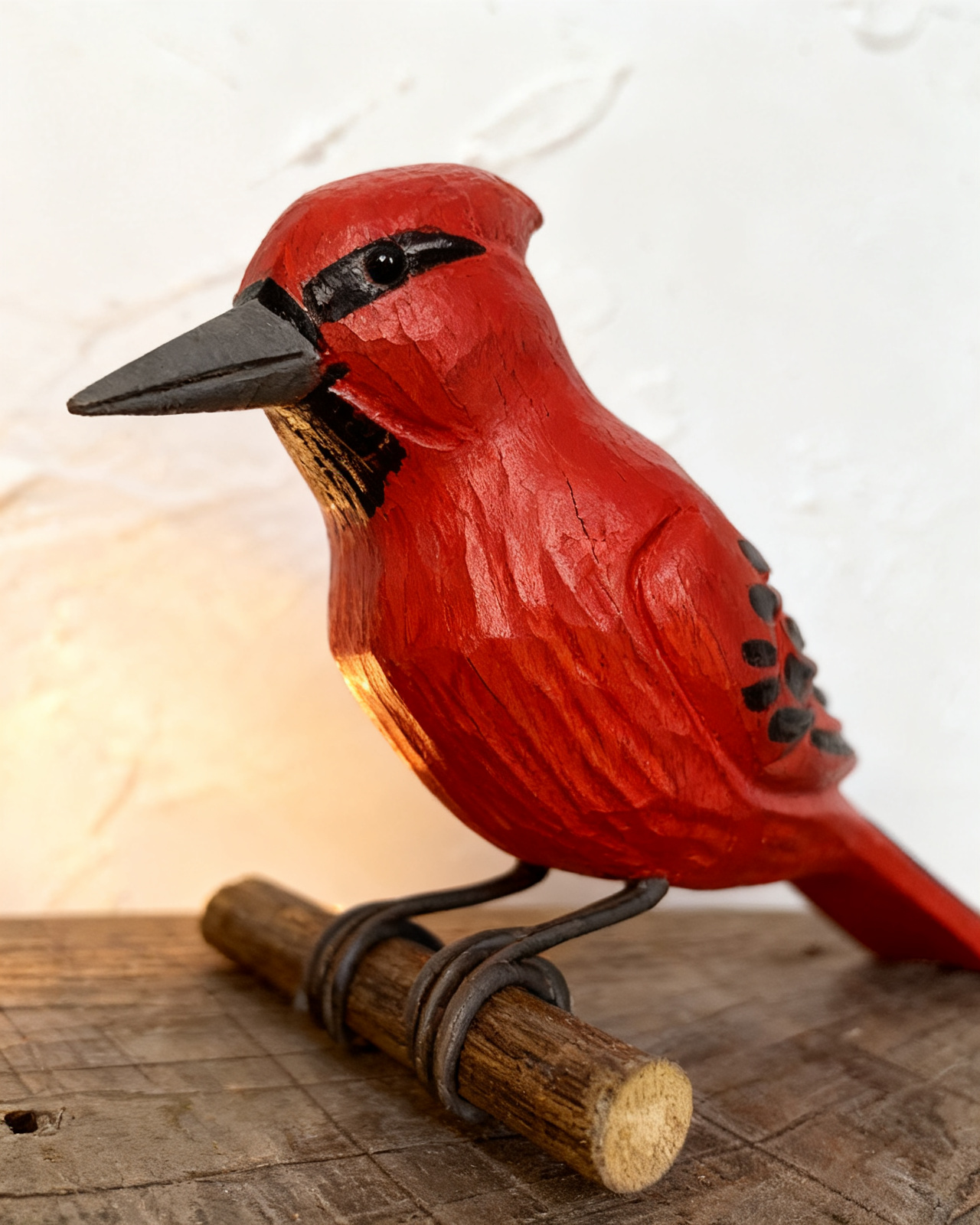
Tilt it to the light: the little long marks in the red are where the brush went. The crisp black mask round the face is brushed freehand, in one pass — the part no machine has managed.
But the colour itself, he says, is only half of it. "A bird like this is made twice. Once with the knife — that's the carver, that's the wood. And once with the brush — that's me. And the brush is the half people actually see." He means it plainly. The very last thing done to each bird is the black mask round the eye and bill, brushed freehand, in one go, at the exact width and angle that makes the bird look sharp and alert instead of muddy and blank. A hair too thick and it sulks. A hair off true and it squints. "That's the bit the machines have never managed," he says. "A machine can copy a shape. It can't paint you a face."
He smiles, not much in it. "Fifty years to learn to do it without thinking. And now I'm thinking about every one, because I know roughly how many I've got left."
How it started — in the paint shop, with a steady hand and a good eye
Bernard did not set out to paint birds.
He went into the Potteries at fifteen, into the paint shop, and stayed half a century. Cups, plates, fine china — lining the gold rim on a teacup, laying the ground colour, the steady freehand work the good ware needed before everything went to spray and transfer. "Red was always the one they gave me," he says. "It's the hardest to lay even, red. Show the boss you can do red clean and you've got a job for life." He had a job for life, near enough, until the trade thinned out and the line work dried up.
It was only in retirement, restless, that he picked up a bare carved bird a friend had made and thought he'd put a bit of colour on it. "First one I did, I did it red. Course I did. Red's my colour." It came out sharp and alive, the way the factory ones never did, and word got round. For a few quiet years it was just Bernard at the kitchen table, and the red birds going out, one at a time, to people who could see the difference.
What sets Bernard's birds apart
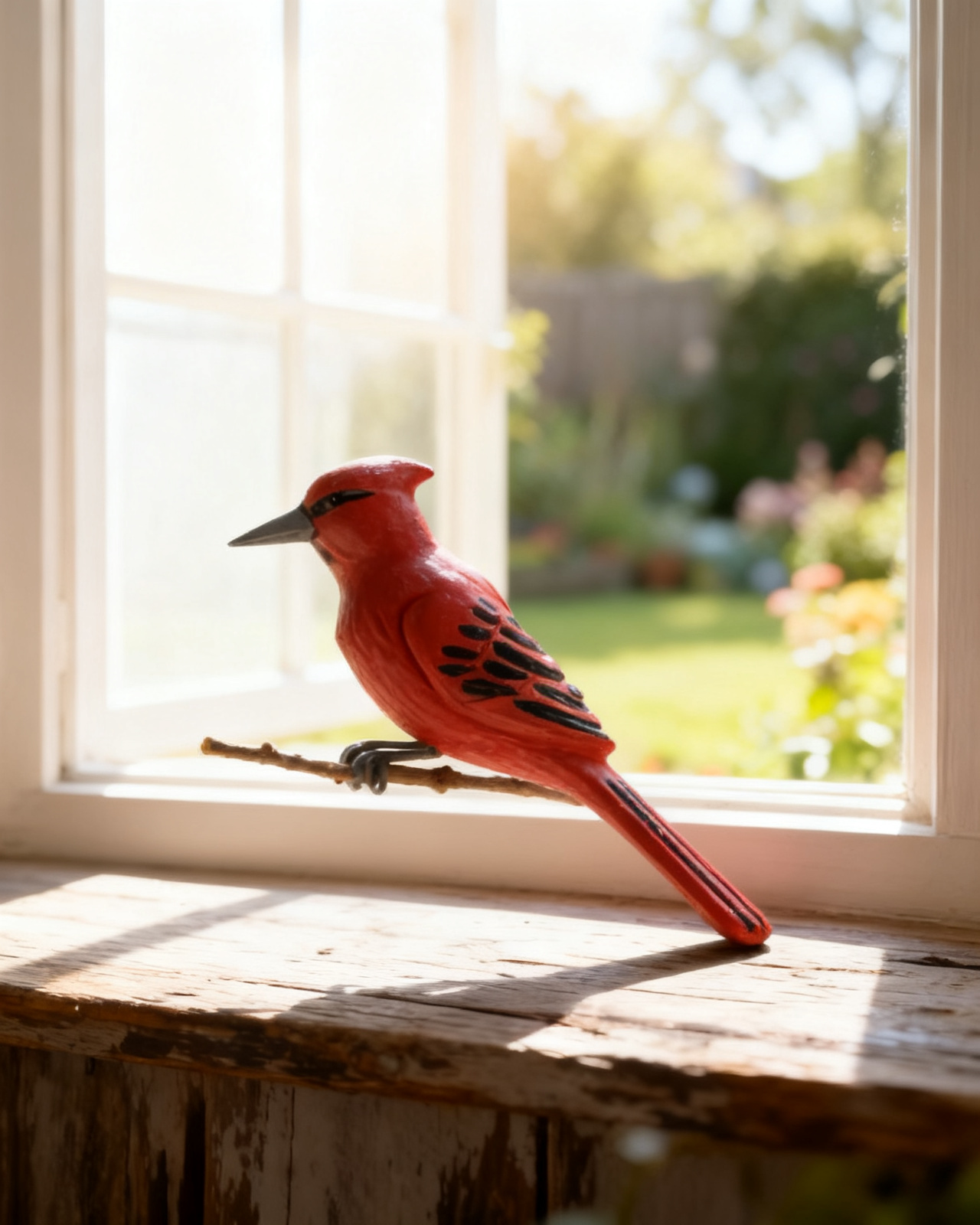
Each bird is carved first, then comes to Bernard bare — and ends as a clean flare of red with the mask set true by hand.
Each bird is carved first by hand from solid wood — never moulded, never printed — and comes to Bernard bare. Then the long work begins: the deep red laid down stroke by stroke and built up so it has depth instead of a flat factory finish; the small crest and the line of the wing picked out; and last of all the crisp black mask round the face, brushed freehand by a man who has been laying colour by hand for fifty years.
- Painted entirely by hand — the deep red is brushed on and built up by eye, stroke by stroke. Not sprayed flat by a gun, not a printed transfer wrapped round the wood. Tilt it to the light and you can see where the brush went.
- The black mask brushed freehand — the line round the face, done in one pass at the exact width that makes the bird look sharp and alert. The part no machine has managed — and the part Bernard is running out of time to do.
- A real painter's red — fifty years laying red onto fine china taught Bernard the one colour most people get wrong. It has depth and life, not the dull, even red of a mass-made ornament.
- One of one, every time — a brush in a hand cannot repeat itself exactly. The depth of the red, the set of the mask, the catch of the light: yours exists nowhere else.
- Carved from solid wood — a real carved body underneath the colour, with the grain running through it, mounted on a slim branch perch — not hollow resin, not plastic.
- Ready for the windowsill — a bold spot of red on its slender perch; at home on a sill, a shelf or a mantel, no feeding, no upkeep. Just colour, in the corner of your eye, all year round.
- From the final batch — every bird here was painted by Bernard's own hand. When they are gone, they are gone.
What people say about Bernard's birds
"It's the red that does it. I've a sprayed robin off a garden centre on the next sill and they're not the same thing at all — his has a glow to it, like it's lit from inside. First bit of real colour in a grey winter."
— Marjorie T., 68, Crewe
"I'll be honest, I half expected 'hand-painted' to mean a sticker. It doesn't. You can see the brush marks in the red and the little black mask is dead crisp. No two on the website were quite alike. Properly done."
— Keith B., 71, Derby
"I bought the red one for my dad, who hasn't long. When I told him a fella painted it who hasn't long either, and that red was always his colour, he sat with it a good while and didn't say much. It meant something to him. To me as well."
— Andrea S., 59, Stafford
The kind of gift someone keeps
What makes one of Bernard's birds such a gift isn't only the carving underneath. It is the colour — laid on by a hand that is running out of time to lay it.
"When you give somebody one of these," he says, "you're not giving them a thing off a shelf that ten thousand others have got. You're giving them something a man sat and painted, right down to the face on it. There won't be more once I'm done. The ones who get one tend to understand that."
Secure one of the last birds
Reserve one of the final hand-painted birds from Bernard's table — each one painted in his own deep red, with the mask set by his own hand — before the brushes are put down for good.
Limited quantity • While stocks last
Conclusion
Bernard Lowe's bird is not just a decorative object. It is a living piece of craft — carved from solid wood, then hand-painted in a deep red by a man who spent fifty years learning to lay that colour true, and who is finishing the last of them now at his own kitchen table.
Some things deserve to be kept. Even when the hand that coloured them is nearly done.
Thank you, Bernard. For fifty years of red — and for every face you ever set true. 🐦✨
Secure yours now → 100% money-back guarantee
DISCLAIMER:
The owner has a financial connection to the products and services promoted on this website. The product/service on this website may be offered by a company outside your local jurisdiction. Return costs are the customer's responsibility and additional charges, such as customs duties or taxes, may apply. Please read the returns policy and cancellation information for further details.
⚠ ADVERTISING | PAID ADVERTISEMENT
This article is a paid advertisement and not independent editorial reporting.
Representation notice
The story told in this article is a fictional advertising presentation. The person "Bernard Lowe", his family, quotations and biographical details are invented and used solely for creative product presentation. They do not describe real people or real events. Images are illustrative.
Customer review notice
The customer opinions shown are example representations and describe possible experiences with the product. Individual experiences can vary. Names have been changed for privacy.
Product notice
The promoted product is a decorative hand-painted wooden bird ornament and may be ordered where available. Statements about "hand craft" and "hand-painted" refer to craft elements in the production and finishing process; materials are natural wood and finishes may vary in grain, colour and markings from piece to piece. The product has no medical or therapeutic effect.
Availability notice
Information about quantity and availability is an estimate and may change. Availability is not guaranteed. The phrase "final batch" / "the last from his table" refers to the current product batch.
Financial connection
The operator of this website has a financial connection to the advertised products and may receive commission for sales made through links on this page.
Notice for UK buyers
UK customers should review the seller information, delivery times and returns policy before purchasing. Depending on the seller's fulfilment location, customs duties, import VAT or handling fees may apply.
Returns
A returns policy applies as stated by the seller. Return shipping costs may be borne by the buyer unless otherwise required by applicable consumer law.
Provider information
Seller: Ecomcloud Trading LLP, 32 Kinburn Street, London, SE16 6DE, United Kingdom. Registration number: OC83840. Email: info@latestfinds.co.uk
© 2026 latestfinds. All rights reserved. This website contains sponsored content and advertising.